# How We Know: Traces, Theories and the History of Science
From cosmic radiation and radioactive clocks to fossils, historical patterns and clinical trials, five books ask how explanations earn—and lose—our confidence.
Source guides: [A Brief History of Time](https://short.zaynjarvis.com/books/a-brief-history-of-time/) · [A Short History of Nearly Everything](https://short.zaynjarvis.com/books/a-short-history-of-nearly-everything/) · [The Lessons of History](https://short.zaynjarvis.com/books/the-lessons-of-history/) · [The Structure of Scientific Revolutions](https://short.zaynjarvis.com/books/the-structure-of-scientific-revolutions/) · [Bad Science](https://short.zaynjarvis.com/books/bad-science/)
## A universe reconstructed from its traces
Nobody watched the early universe expand or followed the first organisms onto land. We infer those histories from things that remain: radiation, rocks, fossils and genetic differences. The interesting question is how an inference becomes strong enough to trust—and how it changes when the traces stop fitting.
Stephen Hawking wrote *A Brief History of Time* to bring modern physics and its philosophical implications to a general audience. Shortform organizes its guide around five questions: Is reality relative or absolute? Is the future predetermined? How did the universe begin? What is a black hole? Can we build a time machine? Bill Bryson’s *A Short History of Nearly Everything* extends the journey from the origins of matter, energy, stars and planets to Earth and living things. These guides provide the natural history below; Kuhn, the Durants and Goldacre will help distinguish changes in the world from changes in how people explain it.
### Same laws, different clocks
The claim that physical laws are the same for equivalent observers does not mean that every observer assigns the same position, speed or elapsed time to an event. Even ordinary motion needs a reference frame. In the guide’s river example, a fish stays above the same patch of riverbed while your boat drifts past. The fish moves relative to the boat, stays still relative to the bank, and moves with Earth relative to the Sun. None of these descriptions supplies a universal state of rest.
Time is more surprising. Consider the guide’s two children firing laser-tag pulses across a moving starship. The ship must travel **below** the vacuum speed of light, *c*. On board, a pulse crosses the ship’s width. An inertial observer outside sees a diagonal path: one leg is the width, the other the distance the ship travels during the crossing. Both measure the same vacuum light speed, so the longer path corresponds to a longer elapsed time. This is time dilation, not merely a delay in receiving a distant signal. [Einstein Online’s account of light speed](https://www.einstein-online.info/en/speed_of_light/).
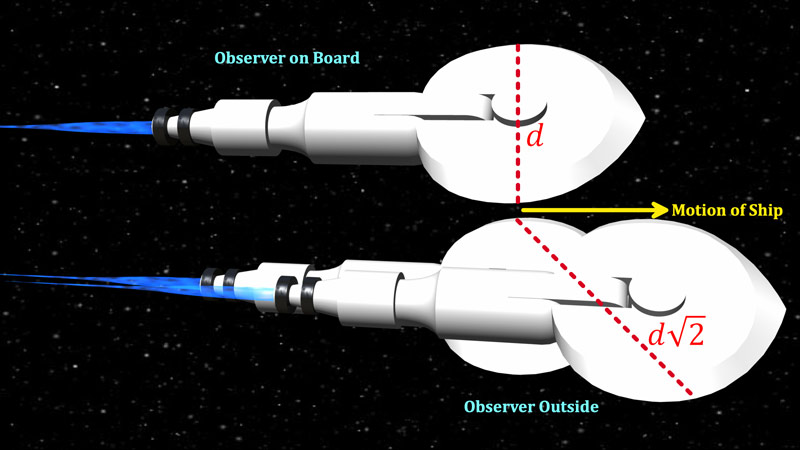
The diagram labels the width *d* and the diagonal *d√2*. That particular geometry corresponds to a ship speed *c/√2*: the ship moves a distance *d* while the pulse covers *d√2*. It cannot depict a massive ship moving at *c*.
Einstein’s special relativity supplies a spacetime description in which these differing measurements agree with one another. General relativity then makes gravity part of that geometry: matter and energy affect spacetime curvature, and freely falling bodies follow its geodesics. The familiar picture of a curved path helps, but spacetime curvature is more than a bent line in ordinary space. Gravity also affects the rate at which clocks run. The two theories extend the earlier mechanics that omitted these effects.
The relativity of speed has familiar everyday applications, such as driving. To avoid collisions, drivers must track the motion of other cars relative to their own, as well as their speed relative to the road—since posted speed limits are implicitly defined relative to the road surface. Maintaining a constant following distance behind another car requires matching its speed so that your relative speed is zero.
### What the speed limit means
Special relativity is most simply introduced using inertial frames in flat spacetime. It can also describe accelerated motion; acceleration alone does not require general relativity. The latter is needed to describe gravitational spacetime curvature. The [travelling-twins analysis](https://www.einstein-online.info/en/spotlight/twins/) is an example of acceleration treated within special relativity.
The invariant speed is light’s speed in a vacuum. In water or glass, light propagates more slowly; at a boundary, a change in propagation speed can change its direction, producing refraction. “Mass increases with speed,” the terminology used in the guide, refers to relativistic mass, energy divided by *c²*. In the invariant-mass convention, the object’s rest mass stays fixed while its energy and momentum grow. The physical consequence is the same: for an object of nonzero rest mass, the required energy diverges as its speed approaches *c*. Particle accelerators test that relation; they do not accelerate a massive particle to *c*. [Relativistic energy and acceleration](https://www.einstein-online.info/en/emc/).
Shortform contrasts this with Pharis E. Williams’s proposed explanation: the electromagnetic influence that accelerates a particle travels at *c*, so it supposedly pushes less effectively as the particle catches up. Its sailboat analogy has wind pushing strongly at first and less strongly as boat speed approaches wind speed. This preserves the intuition of diminishing acceleration, but is a claim from Williams’s alternative account, not a second established derivation of relativity. An electromagnetic field is not wind overtaking a sail, and abandoning “relativistic mass” terminology does not require adopting that explanation.
*Sources discussed here: [Refraction](https://en.wikipedia.org/wiki/Refraction) · [Williams’s alternative physics](https://www.amazon.com/Physics-Against-Odds-Pharis-Williams/dp/061526722X)*
General relativity gives predictions that can be compared with astronomical measurements. In 1915 Einstein accounted for the previously unexplained part of Mercury’s orbital precession: an existing anomaly in Newtonian predictions, rather than a newly discovered deviation. Much later, LIGO measured a passing gravitational-wave signal consistent with two black holes spiralling together and merging. These are different tests of the same framework. [LIGO’s first binary-black-hole observation](https://arxiv.org/abs/1602.03841).
Gravitational waves are disturbances in spacetime geometry. A changing, nonspherical mass distribution—such as an orbiting binary—can radiate them; a massive object moving uniformly does not automatically make a gravitational wave. The source’s mass and motion matter, together with its geometry. Successful tests support the theory in the regimes examined, without proving it complete in every regime.
*Sources discussed here: [Tests of general relativity](https://www.annualreviews.org/doi/pdf/10.1146/annurev.nucl.58.020807.111839) · [About LIGO](https://www.ligo.caltech.edu/page/about) · [GW150914 paper (PDF)](https://arxiv.org/pdf/1602.03841.pdf)*
### Expansion is evidence; an absolute beginning is a further question
Hawking contrasts a universe created at a finite time, as in the Judeo-Christian view he discusses, with the eternal universe favored by many nineteenth-century scientists. The twentieth-century shift was driven by evidence about how the universe changes. The hot Big Bang model describes expansion and cooling from an early hot, dense state. It is not an explosion from one location into empty space. In the balloon analogy, the useful part is the increasing separation of points *on the surface*; the balloon’s center is not a location in that two-dimensional universe. [NASA’s Big Bang explanation](https://science.nasa.gov/mission/webb/big-bang-q-and-a/).
The Bryson guide records an old age range of 10–20 billion years and a commonly cited estimate of 13.7 billion. Those numbers belong to its account, not the present uncertainty range: a modern rounded estimate is about 13.8 billion years. The reconstruction of a hot early universe should also be distinguished from establishing that time had an absolute first instant; whether “before” is meaningful depends on the model of that earliest boundary. [NASA cosmology glossary](https://science.nasa.gov/universe/glossary-3/a-g/).
In the 1920s, Hubble’s distance–recession relation supplied evidence for expansion: distant galaxies tend to recede faster. It does not mean every galaxy recedes from us; motions within gravitationally bound systems need not follow that large-scale trend. General relativity permits a changing universe. Einstein’s historical use of a cosmological constant to construct a static model illustrates how an accepted picture can shape the use of an equation; the constant itself is not mathematically discredited by that unsuccessful purpose.
A second trace is the cosmic microwave background. A hot early universe should leave cooled radiation. Penzias and Wilson detected a nearly uniform microwave signal in the 1960s; its interpretation as relic radiation supported the hot Big Bang. Subsequent measurements of its spectrum and small variations made this a quantitative test, rather than an exact match settled by the first detection. [COBE scientist John Mather on the measurements](https://science.nasa.gov/missions/explorer/measuring-the-big-bang-with-the-cobe-satellite/).
The guide brings together two concerns. One is a **singularity**: under specified classical assumptions, the Hawking–Penrose results show that spacetime descriptions cannot be continued indefinitely along certain paths. Popular accounts picture infinite density at a point. The useful conclusion is that general relativity reaches a boundary of applicability—not that physicists have observed a literal infinity or established a pointlike origin for the whole universe.
The other is **fine-tuning**. In the models discussed, changing the early expansion rate could stop matter from assembling into stars and galaxies or cause recollapse before planetary systems form. The question is why the relevant parameters have life-permitting values. Sensitivity to parameters does not, by itself, calculate the probability of life; that would also require a justified distribution over possible parameters.
The anthropic observation is modest: observers can find themselves only in conditions compatible with their existence. A multiverse proposal tries to turn that selection effect into an explanation by supplying many different conditions; its testability and its assumptions remain questions. Bryson offers a different thought: life evolved to fit its surroundings. That explains adaptation within an available environment, but does not by itself explain why the environment permits stars, chemistry or life at all. Shortform makes this limitation a conjecture about how scientists might respond, rather than evidence of a measured consensus. A quantum theory of gravity might revise the singularity and constrain initial conditions; the guide records Hawking’s hope that it would address both.
Newtonian gravity already makes a static distribution of mutually attracting matter problematic: why would it remain still rather than collapse? This motivates a dynamical question, but does not by itself establish one cosmic point of origin. General relativity supplies a framework for evolving spacetime; quantum gravity would have to address where that classical description fails.
Shortform’s comparison adds inflation as one proposed way to account for the early expansion behavior, while acknowledging that it does not resolve every fine-tuning question. Its account presents Hawking as preferring a theory that explains initial conditions over an appeal to infinitely many universes. That is a characterization of the argument in this guide, not a statement that Hawking rejected every multiverse idea throughout his career. In the proposal described here, a quantum theory would constrain apparently arbitrary parameters and assign substantial probability to the observed values. That remains an expectation, not an established result.
*Sources discussed here: [A Brief History of Time](https://short.zaynjarvis.com/books/a-brief-history-of-time/) · [Limits on life-permitting conditions](https://www.pnas.org/doi/10.1073/pnas.1304212111#sec-3)*
The same questions also appear in theology. Shortform describes Christian arguments that a temporal universe requires a cause outside its spacetime, and that life-permitting parameters suggest design. The causal argument adds a philosophical premise: the universe as a whole must have a cause even if ordinary temporal causation cannot apply before it. Calling such a cause supernatural is part of the interpretation, not something proved by the field equations. Likewise, treating fine-tuning as evidence of a designer is a theological inference, not a physical measurement. These positions differ from Hawking’s search for an account in the laws and initial conditions themselves.
*Sources discussed here: [Theological Big Bang argument](https://reasons.org/explore/publications/facts-for-faith/a-beginner-s-and-expert-s-guide-to-the-big-bang-sifting-facts-from-fictions) · [Theological fine-tuning argument](https://reasons.org/explore/publications/connections/a-dime-s-worth-of-difference)*
### Stars recycle matter
The early universe made mostly hydrogen and helium before expansion and cooling ended that phase of nuclear fusion. Small density differences then allowed gravity to assemble matter into structures; collapsing gas formed stars within the developing galaxies. Bryson reports estimates of 100–400 billion stars in the Milky Way, a range reflecting the difficulty of counting a galaxy from within it.
Stars obtain energy by fusing lighter nuclei into heavier ones. Stellar evolution and supernova explosions help enrich surrounding gas with elements such as carbon, oxygen and iron. Later generations of stars and rocky planets form from that enriched material. Different stars end their lives differently; exhaustion of hydrogen and helium alone is not a universal trigger for a supernova.
Fusion joins lighter nuclei into heavier ones. In stellar burning, fusion toward the iron group can release energy; pushing beyond that region does not provide a continuing energy source. Massive stars develop layers with different fuels: the hot core has advanced farther through nuclear burning, while outer regions still contain lighter elements.
When such a core can no longer support itself, it collapses. A shock and energy transfer involving neutrinos can expel the outer layers; some collapses instead leave a black hole. This is the core-collapse supernova picture. The unused outer fuel matters to the star’s structure, but the explosion is not generally explained by all its surface hydrogen and helium igniting at once. Other supernova classes, including thermonuclear explosions of white dwarfs, have a different mechanism. [Core-collapse mechanisms](https://arxiv.org/abs/1212.4250).
*Sources discussed here: [Nuclear fusion](https://en.wikipedia.org/wiki/Nuclear_fusion) · [Supernova explainer cited by the guide](https://www.space.com/6638-supernova.html)*
Astronomers use sensitive equipment to detect electromagnetic radiation emitted by the hot gases of the early universe, and can even image it. These images show slight intensity variations that correspond to the regional density differences in the primordial gas that eventually allowed stars and galaxies to form.
Estimates of the Milky Way’s stellar population vary because astronomers employ several different methods to measure stellar density—the number of stars per unit volume—and the galaxy’s size. Each method relies on approximations or simplifying assumptions that make a result possible, but also introduce imprecision.
*References: [They can even take pictures of it](https://astronomy.com/magazine/2018/07/decoding-the-cosmic-microwave-background) · [astronomers use several different methods to measure the stellar density](https://astronomy.stackexchange.com/questions/1083/how-do-scientists-know-there-are-about-300-billion-stars-in-a-galaxy-and-there-a)*
### Black holes: inference at the limit of escape
An event horizon is a causal boundary: from inside it, future-directed light signals cannot reach distant outside observers. It is not a solid surface. For a sufficiently massive stellar remnant, the loss of pressure support can lead to collapse and black-hole formation. The gravity of an unseen companion can be inferred from a visible star’s motion; Cygnus X-1 is the historical candidate discussed by Hawking. Later observations added many more candidates and confirmed black holes through several kinds of evidence. The key method is inference from effects, not seeing light emitted by the interior.
Hawking radiation is a quantum prediction of thermal emission associated with a black hole. It does not mean a light ray escapes after being emitted inside the event horizon. Hawking’s calculation treats quantum fields in a black-hole spacetime and predicts outgoing energy with a corresponding decrease in the hole’s mass. [Hawking’s 1975 paper](https://projecteuclid.org/journals/communications-in-mathematical-physics/volume-43/issue-3/Particle-creation-by-black-holes/cmp/1103899181.pdf).
The particle-pair picture is a teaching aid: a positive-energy member escapes while a negative-energy contribution crosses the horizon. “Negative energy” here is defined relative to the distant observer; it is not a synonym for antimatter. The guide’s photon–antiphoton story therefore needs repair: a photon is its own antiparticle, and there is no distinct class of antiphotons preferentially swallowed by the hole. [Fermilab on self-conjugate particles](https://neutrinos.fnal.gov/mysteries/majorana-or-dirac/).
Shortform contrasts the particle-pair story with a quantum-field or energy-density account and cites a commentator’s estimate that emission extends over a region about fifteen times the horizon’s size. The broader lesson is that field calculations can address the radiation’s spectrum and spatial distribution; they need not locate literal pair creation on an infinitesimally thin surface. The particular “fifteen times” estimate is model- and definition-dependent commentary, not a universal boundary of Hawking radiation. Nor did Hawking hide the distinction: his original paper itself presents heuristic pictures and warns against taking them literally before supplying the mathematical derivation.
*Sources discussed here: [Black-hole catalog](https://en.wikipedia.org/wiki/List_of_black_holes) · [Critique of the pair analogy](https://www.forbes.com/sites/startswithabang/2020/07/09/yes-stephen-hawking-lied-to-us-all-about-how-black-holes-decay/?sh=b2995624e63a)*
### Two different absences: dark energy and dark matter
Bryson asks why cosmic expansion accelerates when ordinary attractive gravity would tend to slow it. A cosmological constant can describe an accelerating component in the equations; that is different from explaining its physical origin. The guide also records a period of earlier deceleration followed by later acceleration. The historical irony is that Einstein once used the constant to obtain a static universe, whereas a different value can describe its changing expansion.
Shortform adds alternatives: Williams proposes that weakening gravity could change inferred galaxy distances and imitate acceleration, while another proposal invokes decreasing light speed. These are proposed modifications to the inference and its assumptions. The supplied sources do not establish either as an observationally successful replacement for the standard expansion account; they must not inherit the credibility of the observations they attempt to explain.
*Sources discussed here: [2001 expansion report](https://www.sciencedaily.com/releases/2001/04/010403070934.htm#:~:text=Summary%3A%20NASA%27s%20Hubble%20Space%20Telescope,between%20NASA%20and%20the%20European%20Space) · [Williams’s changing-gravity proposal](https://www.amazon.com/Physics-Against-Odds-Pharis-Williams/dp/061526722X/ref=sr_1_2?crid=2RW4NXSA57XUG&keywords=pharis+e+williams&qid=1671214789&s=books&sprefix=pharis+e+williams%2Cstripbooks%2C396&sr=1-2) · [1999 changing-light-speed proposal](https://www.sciencedaily.com/releases/1999/10/991005114024.htm#:~:text=His%20theory%20could%20also%20help%20explain,expansion%20is%20accelerating.%20Moffat%27s)*
Missing mass is a different problem. Motions and gravitational lensing imply more gravitating matter than the luminous inventory supplies. Bryson’s guide reports a discrepancy of 10–100 times, a source-era range that depends on the system and what is counted as visible matter; it is not one measured ratio for the whole universe.
The guide contrasts dim ordinary objects—asteroids, faint stars and black holes—with matter that does not reveal itself through ordinary light. Shortform then cites scarce microlensing events as a challenge to explaining all the deficit with compact dark objects. That does not mean gravitational lensing generally fails to find dark matter, nor establish that “more clumped” dark matter is today’s prevailing explanation. Microlensing limits one candidate population; large-scale lensing maps a gravitational distribution. Moreover, “dark” need not mean that gravity is its only possible interaction or that nongravitational detection is impossible in principle.
Williams’s alternative, also included by Shortform, changes gravity rather than adding matter. It proposes a gravitational constant that declines over cosmic time: distant bodies would reflect earlier, stronger gravity, with changes propagating at light speed and observations reaching us after a light-travel delay. That is the proposed mechanism, not an established solution of the missing-mass problem. Testing modified gravity requires the same breadth of observations as testing dark matter; repeating the proposal alongside several mysteries does not supply several independent confirmations.
*Sources discussed here: [2012 lensing discussion](https://www.economist.com/science-and-technology/2012/07/07/material-answers) · [2003 microlensing discussion](https://www.economist.com/science-and-technology/2003/04/10/seeing-in-the-dark) · [Williams’s gravity proposal](https://www.amazon.com/Physics-Against-Odds-Pharis-Williams/dp/061526722X/ref=sr_1_2?crid=2RW4NXSA57XUG&keywords=pharis+e+williams&qid=1671214789&s=books&sprefix=pharis+e+williams%2Cstripbooks%2C396&sr=1-2)*
The guide also mentions an excess radio background, tracing related observations to the period of Penzias and Wilson’s work and citing renewed interest in 2009. This should be separated from the cosmic microwave background that supports the hot Big Bang. Explaining the origin and strength of a radio excess is an astrophysical question in its own right. An unexplained signal is a reason to test sources, instruments and models; it does not erase the independent evidence carried by the microwave background.
*Sources discussed here: [Radio-background seminar](https://physics.tamu.edu/events/the-cosmic-radio-background/) · [2009 radio-excess report](https://www.economist.com/science-and-technology/2009/01/08/the-cosmic-boogie-box#:~:text=but%20doing%20science%20can%20sometimes%20be,turn%20out%20to%20be%20worth%20making%20a%20noise)*
## Prediction, uncertainty and the direction of time
### Can a complete theory predict everything?
In the guide’s presentation of **scientific determinism**, knowing the exact state of the universe plus laws that determine its evolution would let one calculate its state at other times, including human actions. Hawking uses this to pose a challenge to free will; whether predictability would make free will an illusion is a philosophical inference, not an experimental finding about human choice.
Shortform groups his discussion into three limits, all considered here in order: **(1) the lack of a complete unifying theory, (2) probabilistic quantum predictions, and (3) quantum limits on an exact specification of the present**. The first is a limit of our theoretical knowledge. The latter two concern the form of the quantum account itself.
Hawking presents a theory applicable across physical contexts as science’s ultimate goal. The first limit is that this unifying theory remains unfinished. General relativity describes gravity through spacetime geometry; quantum theory describes microscopic behavior that a classical account cannot reproduce. The outstanding problem is a fully satisfactory quantum account of gravity, especially where both sets of effects matter.
This is not a division into “relativity for large things, quantum mechanics for small things” with no overlap. Quantum theory can describe many-particle and macroscopic phenomena; quantum fields can also be studied on a prescribed curved spacetime, as in Hawking’s radiation calculation. Difficult many-body calculations and the weakness of individual particles’ gravitational effects are obstacles, but neither is a proof that such systems lie outside quantum mechanics. The deeper unification problem includes making the spacetime geometry itself dynamical and quantum.
Shortform quotes Paul Sutter’s contrast between calculations on flat spacetime and gravity’s curved geometry. This captures a real increase in complexity, but cannot mean that putting a quantum field on any curved background is mathematically impossible. It also describes Williams’s 2011 *Dynamic Theory*: extending the first and second laws of thermodynamics to five dimensions—three of space, one of time and one of mass—and claiming to recover quantum mechanics or general relativity under different simplifying assumptions. Keeping all terms is then claimed to unify them. The source supplies a book description and acknowledges a lack of rigorous testing; it does not demonstrate that this program has solved quantum gravity.
One separate contribution is methodological. Quantum research has also produced tools for probability and statistical modeling. The paper Shortform cites dates to 2003; this is an example of mathematical ideas crossing fields, not evidence that the field is only now beginning or that physics has become fully predictive.
*Sources discussed here: [Sutter on quantum gravity](https://www.space.com/32147-why-is-gravity-so-hard-to-understand.html) · [Dynamic Theory](https://www.amazon.com/Dynamic-Theory-Space-Time-Matter-thermodynamic-foundations/dp/0615447112/ref=sr_1_2?keywords=pharis+e+williams&qid=1637635666&qsid=138-4406796-7491910&s=books&sr=1-2&sres=061526722X%2C0615447112) · [Quantum statistical methods (2003)](https://arxiv.org/pdf/quant-ph/0303013.pdf)*
The second limit concerns outcomes. A quantum calculation gives a distribution of possible measurement results: for a particle, it can show where detection is more or less likely. This is not the classical promise of a known trajectory for every particle. It does not follow that quantum theory makes no precise predictions—its probabilities are themselves testable—or that every part of its mathematics is nondeterministic. In the usual formulation, the quantum state evolves according to an equation, while measurement outcomes are assigned probabilities.
The third limit is easier to grasp if two ideas are kept apart. A **quantum** is a discrete unit associated with a particular physical process; it is not one universal smallest packet of energy. For a photon, energy is *hν*, so changing frequency changes the packet’s energy. Some systems have discrete allowed energy levels, while others have continuous ranges.
The guide uses light scattering to make measurement concrete. To locate a tiny particle with light, the interaction transfers momentum and can disturb the particle. This makes a useful introduction to measurement back-action. But the uncertainty principle is deeper than imperfect observation or an unavoidable fixed “kick” from every photon.
For position *x* and momentum *p*, the standard relation is **Δx Δp ≥ ℏ/2**. The spreads belong to the quantum state’s distributions: narrowing the position distribution raises the minimum allowed momentum spread. It does not require the actual spreads of arbitrary states to vary in opposite directions. Thus even an ideal instrument cannot prepare a state with both spreads arbitrarily small. For a fixed mass in the nonrelativistic setting, momentum is mass times velocity, which explains the guide’s position–velocity wording. [MIT’s derivation from position and momentum wavefunctions](https://ocw.mit.edu/courses/8-321-quantum-theory-i-fall-2017/2ecc07c095d8ae56600f7145c6fb4a6a_MIT8_321F17_lec5.pdf).
This constrains the classical attempt to specify the present exactly and then calculate a unique future path. The quantum description instead evolves a state and makes probabilistic predictions. Uncertainty can affect later position predictions; it need not monotonically increase for every observable in every system.
A ruler offers the contrast. Finer graduations and better calibration can reduce ordinary measurement uncertainty. Quantum uncertainty remains even after that instrumental problem is idealized away. Keeping these two limits distinct prevents a physical constraint from being confused with weak data collection—or from being used as an excuse to stop improving instruments. Related questions about [measurement and causality](https://short.zaynjarvis.com/articles/decisions-systems/en/#theme-evidence-measurement-and-causality) and [probability and calibration](https://short.zaynjarvis.com/articles/decisions-systems/en/#theme-uncertainty-probability-and-calibration) concern different sources of uncertainty.
*Sources discussed here: [Measurement uncertainty](https://en.wikipedia.org/wiki/Measurement_uncertainty)*
### Time travel: three proposals, three different claims
Hawking’s time-machine question concerns returning to the past, not merely experiencing less time than somebody else. Shortform separates three routes.
1. **Speed:** time dilation permits unequal aging, but accelerating a massive traveler beyond light speed is not a physical procedure supplied by relativity. The local light-speed limit alone is not a proof that every general-relativistic spacetime forbids closed timelike paths.
2. **Quantum notation:** antiparticles can be represented mathematically as particles with reversed time orientation; that is not a controllable journey into one’s past.
3. **Wormholes:** hypothetical connections between regions of spacetime could, in some geometries, link events so that a locally forward-moving traveler emerges in an earlier external time.
None of these descriptions supplies a working time machine.
The guide’s two-starship example is worth calculating, because its arithmetic is clearer than its label “pseudo-backwards time travel.” Two sisters leave Earth for a colony 1,000 light-years away. One travels at 99.99995% of *c*, the other at 99.9992% of *c*. Ignoring acceleration and braking, Earth-frame travel times are about 1,000.0005 and 1,000.0080 years, a difference of about 2.74 days. Their elapsed travel times are approximately one and four years respectively.
If the faster traveler started two years older, she arrives about one year younger than her slower sister; at their reunion she has also waited the few extra days. The younger-by-calendar relationship has reversed, but neither traveler has moved backward along her own history. Both arrive roughly a millennium into Earth’s future. This is differential aging, and the faster traveler accumulates about three fewer years—not the slower traveler traveling three years into the past.
The antiparticle representation is similarly easy to overread. It is a mathematical way of relating amplitudes in quantum theory, not evidence that converting matter to antimatter sends it into the past. The guide offers no method to send even a selected particle backward at will, and no basis for extending the notation to an antimatter person as a practical traveler.
Wormholes raise two separate obstacles in the guide: whether a traversable geometry can exist, and whether it remains stable when something passes through. Its ordinary-tunnel analogy—concave walls leave an opening—does not establish the required spacetime geometry or matter properties. Likewise, “any mass makes every wormhole collapse” is too general: stability depends on the model. Shortform itself cites a 2021 theoretical construction in which microscopic particles could traverse a wormhole without collapse. This is a model result, not an observed wormhole or a route for transporting humans. A mathematical solution, physical realizability and an engineering design are three different achievements.
*Sources discussed here: [2021 wormhole model](https://www.sciencedaily.com/releases/2021/03/210309153828.htm#:~:text=Summary%3A%20Researchers%20present%20a%20new,Wormholes%20in%20Einstein-Dirac-Maxwell)*
## Earth keeps an incomplete record
Bryson’s project began with an airplane-window realization: he knew little about the world passing underneath. The science books he remembered from childhood had felt forbidding, so he set out to explain natural history accessibly, from the Big Bang to hominins. His recurring point is that substantial discoveries coexist with unresolved questions.
Shortform organizes this material chronologically into the universe and solar system, Earth’s geology, and life. It explicitly omits most of Bryson’s scientist anecdotes, emphasizes discoveries and uncertainties, and adds comparisons and later research. That editorial layer is useful, but its age and its confidence need to be judged separately from Bryson’s narrative. Earth’s history offers a particularly concrete way to do that: a rock is both material to explain and a record used in the explanation.
The solar system formed about 4.6 billion years ago from gas and dust enriched by earlier stellar generations. Bryson describes planets assembling over roughly 100 million years and the young Earth heated by impacts. Continued asteroid and comet bombardment supplied additional material, including water and carbon; the guide places a particularly intense early interval over about 500 million years. That broad sequence should not be read as a date when the entire surface first became solid, because cooling, remelting and impacts overlapped.
The giant-impact account places a collision with a roughly Mars-sized body around 4.5 billion years ago, with ejected material helping form the Moon. Its stabilizing influence on Earth’s rotation matters for climate, but the stronger claim that most plants—and consequently their animal food chains—could not exist without it is a counterfactual hypothesis. It is not established simply by showing that the Moon affects axial motion.
Meteorites preserve chemical information about the material from which the solar system formed. A 2021 study cited by Shortform used extinct niobium-92 and uranium–lead dating to constrain early enrichment. Its model distinguishes contributions associated with Type Ia supernovae to the inner solar system and a core-collapse supernova contribution to the outer system. This supports a history of different stellar inputs; it does not demonstrate that each group of planets was made mainly from one of exactly two intersecting debris clouds. The suggestion that such enrichment helps explain rocky inner planets and gas giants remains a model interpretation, rather than a direct isotope measurement. [The researchers’ account at ETH Zurich](https://ethz.ch/en/news-and-events/eth-news/news/2021/03/extinct-atom-reveals-the-long-kept-secrets-of-the-solar-system.html).
*Sources discussed here: [Original niobium-isotope study](https://www.pnas.org/doi/10.1073/pnas.2017750118)*
Shortform also retains two historical alternatives to the giant impact: Earth and Moon forming together from the same material, or the Moon forming elsewhere and being captured. Listing these proposals does not give them equal evidential standing. A separate debate concerns habitability without the Moon: some researchers argue that axial changes might be slow enough for life to adapt. That objection addresses the claim that the Moon is indispensable for life, not whether it currently influences Earth’s rotation.
*Sources discussed here: [Moon-origin alternatives](https://www.inverse.com/science/how-did-the-moon-form) · [Habitability without the Moon](https://www.science.org/content/article/who-needs-moon)*
### Clocks made of atoms
A rock’s age is an inference from a physical process, not a label waiting to be read. Uranium isotopes decay into lead at known rates. A suitable mineral can preserve the ratio of parent to daughter isotopes from its formation or later closure to exchange. To interpret that clock, researchers must account for initial daughter material, contamination and later loss or gain of isotopes; melting does not automatically reset every mineral in a perfectly uniform way.
Most surviving terrestrial rocks are younger than Earth: erosion, heating and plate tectonics rework them. Dating meteorites gives access to materials from the early solar system, with the premise that their formation constrains Earth’s formation era. Bryson describes the mid-twentieth-century establishment of an age around 4.6 billion years and the difficulty of avoiding lead contamination. The scientist in his account, Clair Patterson, connected exacting lead measurements with work against environmental lead, including leaded gasoline. The measurement problem and the public-health problem shared a contaminant, though a contaminated sample by itself does not measure population harm.
Different clocks offer different checks. Shortform supplements uranium–lead with four systems; their mechanisms should remain distinct:
| System | What is measured, and why it helps |
|---|---|
| Potassium–argon | Potassium-40 decays in part to argon-40. Argon may escape during heating; retained radiogenic argon in a potassium-bearing mineral can date cooling or closure, provided trapped argon and later loss are addressed. |
| Argon–argon | Neutron irradiation converts potassium-39 into argon-39, which serves as a proxy for potassium. Comparing radiogenic argon-40 with argon-39, with irradiation calibration, avoids separately measuring absolute potassium and argon quantities, improves analytical control and can reveal disturbed histories. Precision is not guaranteed merely by using an isotope ratio. |
| Samarium–neodymium | Samarium-147 decays to neodymium-143, **not the reverse**. Related samples with different parent/daughter ratios can constrain age and initial neodymium composition. The guide highlights ancient volcanic rocks. |
| Rubidium–strontium | Rubidium-87 decays to strontium-87. Ratios normalized to stable strontium-86, together with the parent ratio and an initial-composition model, can date suitable related samples; the guide highlights meteorites. A lone 87Sr/86Sr ratio is not an age. |
Because heat, exchange and contamination affect systems differently, agreement between appropriate independent clocks can expose or constrain errors. It does not remove the need to understand what geological event each clock dates. [USGS isotope parent–daughter table](https://www.usgs.gov/educational-resources/geologic-age-using-radioactive-decay-determine-geologic-age); [argon–argon laboratory method](https://geoinfo.nmt.edu/labs/argon/methods/home.html).
*Sources discussed here: [Samarium–neodymium dating](https://www.chemeurope.com/en/encyclopedia/Samarium-neodymium_dating.html) · [Rubidium–strontium dating](http://hyperphysics.phy-astr.gsu.edu/hbase/Nuclear/clkroc.html#c4)*
### Listening to the interior
Mines and boreholes penetrate only a small fraction of Earth. Seismic waves provide a wider view: their speeds, paths and behavior differ across materials, so records from many stations constrain interior structure. The basic four-layer picture distinguishes a thin solid crust, a mostly solid mantle, a liquid metallic outer core and a solid inner core. The mantle can deform and flow over geological time without being a global ocean of molten rock. Crustal thickness also varies substantially; “a few miles” describes some oceanic crust better than continents. [USGS on Earth’s solid but deformable mantle](https://pubs.usgs.gov/gip/dynamic/unanswered.html).
What keeps the interior hot is a separate question. Residual heat from Earth’s formation and heat from radioactive decay both contribute. That decay is not the same process as a self-sustaining uranium-fission chain reaction. Bryson and Shortform mention a core-reactor hypothesis and an objection that such a reactor would consume its fuel too quickly; they also discuss potassium-40 in the core and uncertainty over how much potassium could be present. These are proposed details of the heat budget, not an exhaustive choice between two established core-heating mechanisms. [USGS on residual and radiogenic heat](https://www.usgs.gov/news/volcano-watch-heat-deep-and-magma-shallow-a-hot-spot-system).
*Sources discussed here: [2003 potassium-core proposal](https://www.sciencedaily.com/releases/2003/05/030508080106.htm#:~:text=with%20its%20half-life%20of%201.3%20billion,the%20magnetic%20field%20for%20billions%20of)*
More detailed seismic models refine that picture rather than simply abolish it. Shortform describes thin transitional regions, a proposed “inner inner” core, large anomalous lobes near the mantle’s base, and deep continental roots compared to inverted mountains. Some models infer that diamonds could contribute to the seismic properties of those roots. These are indirect structural and compositional inferences, with different degrees of resolution—not photographs of uniform layers or mountains made of solid diamond. The useful distinction is between a first-order layer model and heterogeneity within it.
*Sources discussed here: [2008 mantle heterogeneity report](https://www.sciencedaily.com/releases/2008/05/080501154212.htm) · [2005 transition-layer report](https://www.sciencedaily.com/releases/2005/04/050414110928.htm) · [2008 inner-inner-core report](https://www.sciencedaily.com/releases/2008/03/080310131507.htm) · [2018 continental-root diamond inference](https://www.sciencedaily.com/releases/2018/07/180716114538.htm)*
### Continents move; their traces move with them
Plate tectonics is the framework that explains continental drift: Earth’s landmasses and segments of the seafloor move relative to one another, riding on rigid lithospheric plates above a mantle that is mostly solid but deforms over long times. Mantle convection and the forces associated with sinking and spreading plates contribute to motion. Scientists reconstruct the past positions of continents by matching fossils or rock formations unique to a region that were separated as the continents drifted apart. The reconstruction has uncertainties: different fossil assemblages, ages and rock correlations can suggest different maps. This limits a particular reconstruction rather than making all plate tectonics inexact.
Shortform’s “multiple Pangeas” discussion adds a temporal explanation for some mismatches. Pangaea was one supercontinent, not the only configuration the continents ever formed. Repeated assembly and breakup mean that evidence from different ages need not fit the same map. A fossil match only helps when its age and later movement are also taken into account; successive supercontinents cannot automatically explain every anomaly.
*Sources discussed here: [2008 supercontinent study](https://www.sciencedaily.com/releases/2008/08/080822093722.htm)*
### Ice changes the surface—and the terms of the question
Glaciers carve valleys and leave moraines, accumulations of transported rock and sediment. These traces show that ice once occupied places that are ice-free today. Bryson emphasizes ice’s enormous role in reshaping the surface; ranking it above every tectonic process is a narrative judgment, and scattered glacial traces alone do not establish that every place was glaciated.
The mechanisms also operate on different timescales. Changes in orbit and axial tilt redistribute sunlight; volcanic aerosols can cool the climate, while volcanic greenhouse-gas emissions can contribute to warming over other intervals. The timing of repeated glacial–interglacial cycles is strongly linked to orbital variations, with feedbacks amplifying their effects. This is more informative than saying scientists have no consensus about any cause. Abrupt climate changes over decades should not be equated with the complete formation or disappearance of global ice sheets. [NASA on orbital pacing](https://science.nasa.gov/science-research/earth-science/milankovitch-orbital-cycles-and-their-role-in-earths-climate/).
The ice–albedo feedback supplies the amplification: more ice reflects more sunlight, reducing absorbed heat and encouraging further ice growth; less ice exposes darker land or water, increasing absorption and melting. It is the same positive feedback acting in opposite directions, not an explanation of what initiates every switch.
Shortform cites a 2013 modeling discussion of a further interaction. Growing land ice lowers sea level and alters topography; sufficient changes can reorganize ocean and atmospheric circulation, which then changes regional weather and ice growth. That is a proposed switching mechanism within a modeled system. It complements the question of orbital forcing rather than establishing one universally dominant cause of all ice ages. The distinction between a trigger and an amplifying loop also matters in [feedback systems](https://short.zaynjarvis.com/articles/decisions-systems/en/#theme-systems-feedback-and-leverage).
*Sources discussed here: [2013 circulation and ice model](https://www.sciencedaily.com/releases/2013/08/130807134127.htm)*
The word “ice age” can also hide a scale change. A long icehouse interval with persistent polar ice can contain warmer interglacials and colder glacials. We live in an interglacial within such an icehouse. The guide’s statement that the “last ice age” ended roughly 13,000 years ago refers loosely to the last glacial transition, not the disappearance of all polar ice; the Holocene began about 11,700 years ago. [International Commission on Stratigraphy](https://stratigraphy.org/chart/). The much later Little Ice Age, described in the source as beginning roughly 500 years ago and ending roughly 200 years ago, is another, shorter climatic episode. These uses are not three equally plausible answers to one well-defined question. Nor does winter snowfall alone define a geological ice age. Fossils indicating warm polar climates in some earlier eras demonstrate large changes in climate, not tropical conditions at both poles throughout most of Earth’s history.
*Sources discussed here: [NOAA on icehouse climates](https://www.climate.gov/news-features/climate-qa/whats-coldest-earths-ever-been) · [NSF glacial-transition discussion](https://www.nsf.gov/news/news_summ.jsp?cntn_id=117576) · [Ice-age terminology](https://www.britannica.com/science/ice-age-geology)*
Rock and life histories constrain one another. Fossils help locate continents and reconstruct climate; geological context dates and preserves the fossils. Neither record speaks alone. The next question is how to read the sparse record of life without confusing an absence in the archive with an absence in the world.
## Life changes—and leaves uneven evidence
Bryson traces the succession from early microbes to modern humans, asking both what prevailed and how scientists infer it. Three questions need separate answers: how a reproducing system first arose, how lineages diversified once heredity existed, and how their remains entered the record we can inspect.
Miller’s 1950s experiment produced amino acids by discharging electricity through a gas mixture. Since amino acids are protein building blocks, it showed that biologically useful ingredients can form through nonbiological chemistry under the tested conditions. It did not make life. The mixture’s resemblance to the whole early atmosphere was later questioned, so a successful laboratory reaction cannot be mapped directly onto an established history of Earth.
Assembly poses another problem. Linking amino acids into polymers is possible under suitable conditions, but bulk water can oppose the bond-forming chemistry. Proposed watery settings such as submarine vents therefore require an account of energy, concentration and reaction conditions. Modern proteins have particular sequences and folds; drawing their full modern complexity at random in one step is not an adequate origin model. Bryson’s guide discusses simpler precursors becoming more complex, but it does not establish that the first reproducing systems had to begin with proteins. The unresolved task is a plausible sequence from chemistry to heredity and continued evolution, not merely producing one modern molecule by chance.
Computer models can test proposed precursor interactions and reaction pathways, including reactions in water. Shortform’s examples include molecular reaction simulations and a 2021 discussion of algorithms that predict a protein’s three-dimensional structure from its amino-acid sequence. Predicting a structure is different from reconstructing the historical origin of proteins; it helps study molecular constraints, but does not by itself measure how likely life was to arise.
Laboratory synthesis asks yet another question: what can researchers construct with chosen ingredients and procedures? The guide links a 2003 protein-design example and a 2020 improvement in synthesis, alongside construction of DNA in chosen sequences. These dates should not be taken to mean that protein synthesis itself was invented only twenty years before this article. The synthetic-virus example assembles a viral genome and relies on a living host cell to make functioning virus. It demonstrates controlled assembly and the host’s machinery, not independent creation of a cell or a replay of life’s origin.
*Sources discussed here: [2009 precursor-protein study](https://www.sciencedaily.com/releases/2009/08/090829091049.htm#:~:text=could%20easily%20be%20generated%20from%20this,able%20to%20take%20the%20next%20step%3A%20that) · [Stanford reaction simulation](https://mtzweb.stanford.edu/research/ab-initio-nanoreactor) · [2021 protein-folding discussion](https://www.economist.com/leaders/2021/07/31/remarkable-progress-has-been-made-in-understanding-the-folding-of-proteins#:~:text=amino%20acids%20are%20just%20too%20complex,make%20comparatively%20large%20amounts) · [2003 protein design](https://www.sciencedaily.com/releases/2003/10/031031064026.htm#:~:text=natural%20proteins%20with%20good%20structures,water-loving%20units%20--%20no%20matter%20which) · [2020 protein synthesis](https://news.mit.edu/2020/faster-protein-synthesis-0528) · [2003 synthetic-virus report](https://www.nature.com/articles/news031110-17)*
### Common ancestry and the design objection
Shared genetic machinery and conserved proteins support common ancestry across modern life. Explaining heredity and variation is different from explaining the first origin of that machinery. Genetics later supplied a mechanism for transmitting traits that Darwin’s account could not fully specify.
Evolutionary ideas preceded Darwin. Robert Chambers anonymously published *Vestiges of the Natural History of Creation* in 1844, advocating a developmental history that included human kinship with other primates; Darwin’s *On the Origin of Species* appeared in 1859. The guide’s “fourteen years” is an imprecise interval. [Darwin Correspondence Project on the 1844 book](https://darwinproject.ac.uk/letter?docId=letters%2FDCP-LETT-4939.xml). More importantly, earlier ideas about species changing are not identical to Darwin’s developed case for natural selection. His contribution was not simply greater courage in accepting credit for an already-complete explanation. Controversy mattered to whether people attached their names to evolutionary proposals, but the mechanisms and evidence also mattered.
Paley’s watchmaker argument addresses a different kind of explanation: intricate organization, he argued, points to an intelligent maker as a watch points to a watchmaker. That is a design inference. Its appeal and its limitations can be examined without confusing it with a test of genetic inheritance.
*Sources discussed here: [Origin of Species (1859)](https://en.wikisource.org/wiki/On_the_Origin_of_Species_%281859%29)*
Lamarck had proposed an evolutionary theory earlier still. Shortform uses criticism of his work to explain why later writers might have hesitated to publish under their own names. The narrower historical point is that reception changed; saying criticism simply ended his scientific career is too definite for the supplied evidence.
Shortform develops three design arguments. First, cellular motors, valves and other molecular machinery resemble some human-built mechanisms. Second, advocates of “irreducible complexity” argue that a system whose current function depends on every part could not have evolved through functioning simpler stages. Third, they appeal to the still-unresolved origin of life and interpret shared genetic language as evidence of one designer rather than common ancestry.
The first observation is a functional analogy, not proof of a shared manufacturing process. The second depends on excluding other earlier functions: components can be co-opted, so failure after removing a part today does not show that no precursor was useful. The third proposes an intentional cause without supplying a testable assembly mechanism. The absence of a complete origin-of-life account does not reverse the evidence for evolution after heredity exists. These arguments remain relevant to intellectual and religious history, but they do not acquire equal scientific standing merely because they challenge a scientific theory.
*Sources discussed here: [Survey of evolution views](https://www.pewresearch.org/fact-tank/2019/02/11/darwin-day/) · [Lamarck’s historical context](https://evolution.berkeley.edu/the-history-of-evolutionary-thought/1800s/early-concepts-of-evolution-jean-baptiste-lamarck/) · [Behe’s design argument](https://www.simonandschuster.com/books/Darwins-Black-Box/Michael-J-Behe/9780743290319) · [Earlier functions and co-option](https://content.csbs.utah.edu/~rogers/tch/evidevol/ircomp/index.html) · [Common-designer argument](https://reasons.org/explore/publications/articles/alu-sequences-in-primate-genomes-evidence-for-common-descent-or-common-design)*
### Oxygen changes what life can do
An early atmosphere with little free oxygen favors an anaerobic account of early microbial life. Later oxygen-producing photosynthesis transformed the environment. Oxygen was toxic to many anaerobes, while anaerobic organisms persist in oxygen-poor places such as some swamp sediments. The shift made energy-intensive forms of life possible, but it was not a single instant when every organism changed.
Mitochondria produce usable cellular energy by oxidizing nutrients and are central to the history of complex eukaryotic cells. Their distinct DNA is one line of evidence for an endosymbiotic origin: an ancestral bacterial partner became integrated with a host lineage. The guide’s simple “bacterium invaded another bacterium” story is a sketch of that relationship, not a settled identification of the host. Eukaryotic cells subsequently supported multiple forms of multicellular life.
The Cambrian explosion names a geologically rapid diversification of animal forms around 540 million years ago, not the first appearance of all plants or all multicellularity. Aquatic life already had a history. Bryson’s central caution survives the correction: abrupt appearance in a fossil collection is not necessarily abrupt origin in nature.
Larger bodies and hard parts are easier to recognize and preserve than many small, soft organisms. Fossilization also requires suitable conditions, so the record samples past life unevenly. The guide reports an estimate that only one in 10,000 species that ever lived is represented by fossils; treat it as Bryson’s scale-setting estimate, not a directly countable sampling fraction. The important mechanism is selective preservation, which must be considered alongside genuine biological diversification.
Two disputes show why a chronology is also a model. For photosynthesis, Shortform cites molecular comparisons suggesting that the machinery for oxygen production could predate the last common ancestor of described oxygen-producing cyanobacteria by roughly a billion years. The analysis modeled the history of photosystem II proteins; water-splitting ability in an ancestral system is an inference, and oxygen production at that early date remains a hypothesis. [Cardona and colleagues](https://onlinelibrary.wiley.com/doi/10.1111/gbi.12322). This concerns the ancestry of photosynthetic machinery, not a finding that modern plants and cyanobacteria simply split into two organismal lineages a billion years before cyanobacteria existed. A lag between oxygen production and atmospheric accumulation would need explanation. The source discusses phosphorus limitation: small populations might produce oxygen without transforming the whole atmosphere, with later nutrient availability allowing expansion. The guide cites geological evidence of increased phosphorus around the oxygenation interval as support for that proposal; an association in the record still needs a causal mechanism. It also records a more speculative symbiotic origin in which two early bacteria combined to form a double-membrane organism. These are distinct proposals about machinery, ecology and cellular integration.
For animal history, the guide contrasts a rapid Cambrian radiation with a much longer, poorly fossilized prehistory. Molecular clocks infer separation times from genetic differences and assumptions about rates; a study reported in 1999 gave an estimate near 1.6 billion years for the common ancestor of animals. That is an old model result, not the agreed animal-origin date. Independent lineages acquiring hard exoskeletons could also produce an apparent fossil “explosion.”
Trace fossils add another kind of evidence. Large living single-celled organisms can leave trails, so a trail alone does not necessarily identify an animal. But that general alternative does not refute every specific body-and-trace fossil: a 2019 study described a segmented bilaterian, *Yilingia*, with associated late-Ediacaran traces. [The primary fossil report](https://www.nature.com/articles/s41586-019-1522-7). Likewise, the 2013 study behind the guide’s “five times” figure estimated average Cambrian rates around four times higher for phenotypic traits and 5.5 times higher for molecular change than later Phanerozoic rates, in an arthropod analysis conditional on its clock models; it did not measure a universal mutation rate five times higher for all Cambrian life. Faster evolutionary change and incomplete preservation can both matter. [The rate study](https://pubmed.ncbi.nlm.nih.gov/24035543/).
*Sources discussed here: [2018 photosystem-history report](https://www.sciencedaily.com/releases/2018/11/181127131552.htm#:~:text=Other%20scientist%20think%20that%20cyanobacteria,prevented%20oxygen%20from%20accumulating) · [2016 phosphorus proposal](https://www.sciencedaily.com/releases/2016/12/161221132815.htm#:~:text=celled%20organisms%20to%20rudimentary%20multicellular,evolved%20only%20this%20one%20time%20in%20Earth%27s) · [2009 symbiosis proposal](https://www.sciencedaily.com/releases/2009/08/090819135436.htm#:~:text=organisms.%20At%20the%20time%20these%20two,oxygen-breathing%20organisms%20could) · [1999 molecular-clock estimate](https://www.sciencedaily.com/releases/1999/01/990121073459.htm#:~:text=says%20the%20scientific%20question%20must,species%20long%20before%20the%20Cambrian) · [2019 body-and-trace fossil report](https://arstechnica.com/science/2019/09/new-fossil-find-reveals-some-of-the-first-mobile-animals/) · [2008 single-celled tracks](https://www.sciencedaily.com/releases/2008/11/081120130531.htm#:~:text=puzzled%20Charles%20Darwin%20and%20remains,could%20be%20the%20Precambrian%20ancestors) · [2013 arthropod-rate report](https://www.sciencedaily.com/releases/2013/09/130912131753.htm#:~:text=accelerated%20evolution%20was%20sufficient,The%20research%20focused%20on%20arthropods)*
### Out of the water, through repeated losses
Bryson’s guide links the move onto land to competition in shallow coastal waters and limited coastline when landmasses clustered together. That is a proposed pressure, not a single established cause of every terrestrial transition. Nor did life first step onto land as tree ferns and giant club mosses: simpler land plants preceded those later forests. The source’s named plants still illustrate the expansion of terrestrial vegetation. Millipedes and crustaceans belong to its account of early land animals; vertebrates then diversified into terrestrial amphibian and reptile lineages, with birds and mammals appearing later. [Research on early land plants](https://www.nature.com/articles/s41477-018-0140-y).
Mammals coexisted with dinosaurs, often in small-bodied forms compared in the guide to mice and gophers. Their later expansion into large-bodied forms followed the extinction of non-avian dinosaurs. That ecological opening matters more than treating every early mammal as an identical burrowing animal.
Bryson highlights terrestrial plants and invertebrates, but other researchers—such as paleontologist Neil Shubin—place greater emphasis on the emergence of terrestrial vertebrates, because that transition is especially informative about our own body plan. In *Your Inner Fish*, Shubin argues that studying the first fish that crawled onto land using primitive limbs provides deep insight into all animals descended from them—reptiles, amphibians, birds, mammals, and ultimately humans—because the shared features of all these creatures become clearer when their differences are understood as variations on an original body plan. Shubin also describes how his team discovered fossils of fish with primitive legs, which helped unlock many of these insights.
*References: [Your Inner Fish](https://www.shortform.com/app/book/your-inner-fish) · [his team discovered fossils of fish with primitive legs](https://www.shortform.com/app/book/your-inner-fish/chapter-1#finding-the-earliest-land-creature)*
Mass extinctions periodically removed large fractions of existing species and changed which lineages could expand. Bryson’s guide gives the end-Cretaceous event as 65 million years ago and about 70% of species, and the end-Permian event as 245 million years ago and about 95%. Those are source-era numbers; the widely used boundary dates are roughly **66 million** and **252 million** years ago, while extinction percentages depend on the organisms and records counted. [International chronostratigraphic chart](https://stratigraphy.org/chart/)
The guide lists impacts, volcanism, disease, solar activity and climate disruption as proposed causes across extinction events. A list of possibilities is not equal support for each. The end-Cretaceous impact has direct geological evidence; the source’s broader point is that catastrophic environmental change can interrupt a lineage’s apparent success. Causes must be established event by event rather than inherited from a generic disaster list.
### A branching human history
Humans are apes; the relevant split is between the lineage leading to humans and the lineage leading to chimpanzees and bonobos, roughly six to seven million years ago. It is not a separation of humans from every other ape at once. *Homo erectus* appeared about two million years ago and spread from Africa into parts of Eurasia. Upright walking predates it, so “becoming human” cannot be assigned to one sudden package of traits in this species.
The guide infers behavior from tools, fire traces and the survival of impaired individuals. These are different kinds of evidence, with different uncertainties. Learning a stone-tool procedure by imitation does not establish that *Homo erectus* had an infant’s overall intelligence. Similarly, survival with an injury can motivate an inference of care, but cannot by itself identify every feature of a social system.
The guide preserves an older dispute between a recent African origin of modern humans and multiregional transformation from *Homo erectus*. It gives 100,000 years for early *Homo sapiens* and even cites a 25,000-year northern-African ancestral population. Those cannot serve as present dates for our species’ origin: fossils place *Homo sapiens* in Africa around 300,000 years ago. [Smithsonian’s species account](https://humanorigins.si.edu/evidence/human-fossils/species/homo-sapiens).
The methodological tension remains useful. DNA comparisons infer ancestry using divergence and demographic models. Tool distributions trace behavior and transmission, not genes directly. The absence in East Asia of a particular African toolkit therefore cannot, by itself, prove independent biological origins; people can migrate while technologies change, fail to preserve, or spread differently.
*Ardipithecus*, represented by fossils around four million years old, combines features associated with climbing and upright movement. This warns against picturing the last common ancestor as a modern chimpanzee. It does not identify that ancestor or prove that the two later branches simply perfected opposite halves of its abilities. The source’s “closest relative found” should not be treated as a ranking established from all known fossils.
Australopithecines are not collectively an evolutionary dead end. Their fossil record is older than that of *Homo erectus*, and some later members overlapped with early *Homo*. Overlap is compatible with a branching ancestry: an ancestral population need not disappear when a descendant lineage arises. The exact connections remain matters for particular fossils and species, rather than an all-or-nothing choice for the entire group.
Shortform says that tools and evidence associated with fire occur at multiple sites, whereas its particular care-for-an-injured-individual example rests on one fossil. That difference in evidential base must remain visible. It does not justify the original bundle that nearly everything known about *Homo erectus* came from one Kenyan site.
Hybridization makes family trees more complicated still. When hybrid offspring are fertile, combining existing variation can sometimes produce a new lineage within a few generations. In one directly documented case involving Darwin’s finches, reproductive isolation developed in just three generations. This is a timescale demonstrated in that lineage, not a rule that any viable hybrid becomes a new species or an estimate of how quickly modern humans arose. [The finch study](https://pubmed.ncbi.nlm.nih.gov/29170277/). The guide recounts a proposed sequence involving African *Homo heidelbergensis*, dispersal, Neanderthals and Denisovans, followed by hybridization contributing to modern humans. That sequence is an older schematic hypothesis, not a complete accepted genealogy.
The existence of some interbreeding is now better supported than the guide’s evenly balanced “interbreeding versus merely shared ancestry” debate suggests. Ancient DNA demonstrates gene flow involving modern humans, Neanderthals and Denisovans. This does not mean modern humans originated simply by mixing those latter two groups. African origins and later interbreeding can both be true. [The 2022 Nobel scientific account of ancient genomes](https://www.nobelprize.org/prizes/medicine/2022/advanced-information/).
*Sources discussed here: [2009 Ardipithecus study](https://www.sciencedaily.com/releases/2009/10/091001110548.htm#:~:text=chimpanzees%20is%20thought%20to%20have%20lived,this%20ancestor%27s%20characteristics.%20For) · [Homo erectus ancestry](https://www.discovermagazine.com/planet-earth/homo-erectus-what-do-we-know-about-our-early-ancestors) · [Overlapping hominin lineages](https://www.smithsonianmag.com/science-nature/homo-erectus-australopithecus-saranthropus-south-africa-180974571/) · [Inferring behavior from tools](https://australian.museum/learn/science/human-evolution/how-do-we-know-how-they-behaved/) · [Evidence of fire](https://www.scientificamerican.com/article/quest-for-clues-to-humanitys-first-fires/) · [Hybridization and new lineages](https://www.economist.com/science-and-technology/2020/10/03/how-hybrids-have-upturned-evolutionary-theory#:~:text=000%20years%20ago.%20There%20were%20probably,and%20still%20roamed%20southern%20Africa) · [2011 archaic-gene-flow report](https://www.sciencedaily.com/releases/2011/09/110907171533.htm#:~:text=Neanderthals%20into%20non-African%20offspring,extinct%20archaic%20humans%20who%20lived) · [2012 shared-ancestry alternative](https://www.sciencedaily.com/releases/2012/08/120813155521.htm#:~:text=would%20be%20expected%20between%20a%20random,expanded%20out%20of%20Africa%2060-70K%20years)*
Humans also change which species survive. Bryson names the dodo, passenger pigeon and Carolina parakeet as losses associated with human activity, including hunting. His judgment that people often killed merely because they could conveys the waste he wants readers to confront; it is not a complete species-by-species causal account. In prehistory, human arrival often coincided with regional extinctions. That pattern supports investigating human impacts alongside other environmental changes, while coincidence alone does not apportion each cause.
Shortform sets two interpretations beside that history. Some Christian and Jewish accounts invoke human fallenness: people have an inclination toward wrongdoing, though individuals may overcome it. Another account speculates that once-useful hunting dispositions persisted after conditions changed, comparing human behavior with predators that kill available prey beyond immediate need—the so-called henhouse syndrome. These are not two exhaustively opposed scientific hypotheses. The first is theological; the second is an evolutionary conjecture that would need evidence connecting inherited behavior to these extinctions. Evolutionary explanation does not itself require atheism, nor does predatory surplus killing establish a human “extinction instinct” in DNA.
Shortform also brings in Hawking’s *Brief Answers to the Big Questions*. His argument for settlements on multiple planets treats past mass extinctions as a warning against keeping every human population on one vulnerable world. That is a proposal to reduce some shared risks, not a demonstrated guarantee of survival or proof that every alternative is futile. It puts a practical question beside Bryson’s concern: which vulnerabilities would dispersal actually separate, and which would it carry along?
*Sources discussed here: [Theological fallenness](https://www.christianity.com/wiki/bible/what-is-the-fall-of-man-genesis-3-explained.html) · [Surplus-killing analogy](https://www.scienceabc.com/nature/animals/do-animals-only-kill-for-survival-henhouse-syndrome-hunting.html) · [Brief Answers to the Big Questions](https://www.shortform.com/app/book/brief-answers-to-the-big-questions) · [Hawking’s space-settlement argument](https://www.shortform.com/app/book/brief-answers-to-the-big-questions/1-page-summary#the-future-of-human-expansion)*
Bryson frames his account of science by highlighting two overarching themes: the many unsolved mysteries that remain across the sciences, and the deeply human side of scientists and their work. He relates anecdotes about both famous and little-known researchers who made important discoveries only to see credit go to others. Scientists throughout history had vices, foibles, insecurities, relational struggles, and personal biases just like anyone else; more than a few nursed bitter rivalries. Because of these human factors, science did not advance smoothly but progressed by fits and starts.
## What can human history generalize?
### Human motives beneath changing institutions
Will and Ariel Durant’s *The Lessons of History* roots its account of recurring historical patterns in biology: humans are subject to the same trials of selection and struggle for existence as all other animals, and the group or nation merely inherits the will of the individuals who compose it. Human nature has remained largely unchanged across history; the means of action shift, but the underlying motives stay the same. Because humans are born with unequal abilities, inequality is a natural consequence, and the growing complexity of civilization magnifies it, as each invention is seized by the strong to increase their own advantage while leaving the weak worse off.
These are historical generalizations, not deductions that biology makes every invention worsen the position of the weak. The explanatory question is which institutions turn differences into durable advantage.
For the Durants, unrestricted freedom and equality of outcomes pull against each other. If people are granted full freedom, their natural differences in ability will produce unequal outcomes; if equal outcomes and equal demonstrated ability are forced, freedom is diminished. In a free society, the most egalitarians can reasonably hope for is approximate equality of legal justice and educational opportunity. Society itself is composed of an imitative majority and an innovating minority; history is broadly the "conflict of minorities," while the majority applauds the victor and supplies the human material for social experiment.
The conflict here is chiefly between unrestricted freedom and imposed equality of outcomes. It should not erase the distinction between outcomes, rights and opportunities; nor does biological difference decide which inequalities are just.
They also argue that every economic system must ultimately rely on some form of profit motive to motivate productivity; alternatives such as slavery, brute-force management, or ideology have historically proved too unproductive or unsuccessful.
Their political account begins with a recurring friction: the tension between rulers and the ruled. The natural progression of government moves from monarchy to aristocracy to democracy and back again; democracy gives way to monarchy or tyranny when civil strife weakens the state, revolution looms, and a figure emerges promising security and opportunity for all. Like a heartbeat, societies alternate in cycles of wealth concentration and redistribution, which may be either violent or peaceful. In the authors’ twentieth-century comparison, communism had adopted capitalist features to stimulate productivity, while capitalism had incorporated socialist programs to defuse discontent over inequality, so the two systems converge.
### War as a constant of history
The Durants regard war as a constant of history, driven by the same motives that lead individuals to fight: securing more resources and power, asserting pride, and surviving under threat. The state inherits individual will but without the normal moral and social boundaries that constrain individuals; a sufficiently strong state defies outside interference with its will and acknowledges no higher authority to which it is answerable. Philosophers may muse about the futility of war, but generals understand that war is the final arbiter of history. Counting only through its own writing era, *The Lessons of History* reports that of 3,421 years, just 268 were free of documented war.
The 3,421-year count and 268 war-free years are the authors’ historical tally, not an updated dataset or a forecast of how often any particular state must fight.
### The persistent role of religion in society
In the Durants’ account, religion has been a constant presence throughout history, with both stabilizing and corrosive effects. On the positive side, religion has offered "supernatural comforts" to many people, even the most unfortunate, and has provided social stability through divine surveillance and moral prescriptions handed down by the gods. On the negative side, it has been used as a tool of the state to legitimize power and has been marked by corrupt abuses of authority, as seen in the Crusades. The book summarizes the persistence of religion with the line: "As long as there is poverty there will be gods."
For the Durants, culture, customs, and morals serve as a valuable stabilizing force in society, though they also dampen innovation. Practices that survive to the present day have endured because they worked across generations; new changes should be tested in the crucible of criticism before overturning the results of centuries of accumulated social experiment. Morals themselves shift with the times, reflecting what is necessary for a society to grow and survive. The book illustrates this with the shifting moral emphasis of successive economic modes: hunting-and-gathering societies prized survival above all, including fighting and killing, and tolerated gluttony during rare feasts; agricultural societies elevated hard work and regularity over violence and bravery; industrial societies fostered individualism detached from the family, materialism and mass consumption, and the delay of marriage alongside premarital sex.
Their argument makes inherited practice a reason for investigation and caution, not proof of universal benefit. A practice can persist through unequal power as well as through useful adaptation; deciding to preserve it still requires asking whom it serves.
### The regular growth and decay of civilizations
The Durants describe civilizations as growing and decaying with striking regularity. Decay typically begins when leadership fails to meet new challenges, whether natural or manmade, and is often finalized by a defeat in war. Yet even if the fall of a civilization is likely inevitable, it need not be lamented: what a civilization creates can achieve immortality. As the book notes, more people read Homer today than in his own time.
## When the framework changes
The Durants look for recurring patterns in civilizations; Thomas Kuhn asks what changes when a scientific community reorganizes its standards. A simple cumulative picture makes science a pile of facts that never requires rebuilding. *The Structure of Scientific Revolutions* instead distinguishes cumulative work within a framework from episodes in which the framework changes.
Kuhn’s evolutionary analogy describes movement away from explanations that no longer work, without promising a predetermined final theory. That differs from Hawking’s aspiration to a unified physical account. They address different questions—how communities develop knowledge and what scope a physical theory might achieve—but there remains a real tension over whether scientific progress needs a final destination. One should not dissolve it by announcing that both authors endorse the same model, or turn Kuhn’s historical argument into proof that there is no objective world.
Shortform’s six-part vocabulary makes the pattern recoverable:
1. **Normal science:** research within an accepted framework.
2. **Puzzle-solving:** resolving problems that the framework makes tractable.
3. **Paradigm:** shared exemplary achievements, concepts and ways of working that organize a field. The guide uses descent from an ape-like ancestor as an example of a guiding idea in evolutionary biology; a paradigm is broader than one isolated claim.
4. **Anomaly:** a result or observation that does not fit the framework’s expectations.
5. **Crisis:** confidence is sufficiently strained that basic assumptions and alternatives become open to dispute. Resistance and dismissal can occur, but not every unresolved discrepancy creates a crisis.
6. **Revolution:** a new paradigm replaces the old one, changing the questions and standards of subsequent work.
This is a vocabulary of linked activities and states, not six steps that every laboratory must execute in order.
### Why routine research can unsettle its own framework
Normal science is the everyday work of scientists operating within a paradigm, focused on solving puzzles and resolving discrepancies within that framework. Though *The Structure of Scientific Revolutions* may at times sound dismissive of normal science, the author held it in high regard.
Normal science does not ordinarily aim to overthrow its paradigm; most research published in journals follows three recurring trends: determining facts; matching those facts to established theory, which may involve slight adjustments to the theory; and developing and articulating those theories, with attention to their broader implications.
Even though normal science does not seek out departures from the paradigm, it is exceptionally effective at uncovering anomalies that fail to fit the current framework. This is because, while normal science narrows the breadth of what scientists investigate to what the paradigm permits, it enables a depth of study that would otherwise be impossible: researchers can devote extensive time and effort to examining minute details of the natural world.
The precision of normal science can reveal what the paradigm fails to predict. Yet researchers do not always recognize an anomaly at once: familiar expectations may make an awkward result look like error or a solvable detail. Resistance can delay recognition, while patient work can also show that an apparent anomaly was not a failure of the framework.
Shortform connects this to Karl Popper’s conjectures and refutations: formulate a testable claim, expose it to criticism, and revise or reject it when the evidence warrants. The overlap is attention to failed expectations. The difference is that Kuhn describes extended work protected by a paradigm as well as revolutionary change; he is not merely proposing Popper’s criticism on a larger scale. Neither account requires that every test must inevitably falsify its target.
A crisis is precisely the moment when two or more paradigms compete to be adopted as the field's standard framework. It is a period of scientific upheaval, in which researchers are willing to try anything and debate even the most basic understandings of the field. Out of that ferment come new ideas and, eventually, new theories.
Even when an anomaly is so large that a paradigm clearly must be rejected, the decision is never simple. A paradigm cannot be rejected merely because it faces a problem; it must be replaced by another paradigm that both solves the problem and promises to handle future puzzles at least as well as the current one. Making that replacement requires comparing the two paradigms both to each other and to what has been observed in the world. These new theories eventually solidify into a fresh established paradigm, and from certain perspectives, scientists thereafter find themselves working in an altogether new world.
### Incommensurable does not mean evidence-free
Rival paradigms may differ in the problems they prioritize, the standards they use and even what familiar words mean. This is **incommensurability**: there need not be one neutral scale on which every disputed feature can be ranked mechanically. It is not an inability to compare anything at all.
Scientists can still compare accuracy, important solved problems and promises of further work, while disagreeing about the weight or interpretation of those achievements. This explains why Kuhn sometimes likens adoption to conversion and why communication across paradigms can be difficult. It also connects to specialization: communities can branch into different research programs. The biological analogy captures branching and adaptation, but does not make scientific theories organisms or make acceptance independent of evidence.
Shortform itself warns that its shorthand “unable to be compared” conflicts with its description of scientists comparing paradigms. The distinction above repairs that simplification: lacking a fully shared measure does not prohibit reasoned comparison. A crisis tests both how well an alternative handles observations and what counts as an important success. Neither stubbornness alone nor a single spectacular anomaly supplies the entire explanation.
History has seen many such revolutions that completely transformed how people understood and approached the world. The Greeks inaugurated a mathematical revolution by creating proofs that showed not only that certain formulae and postulates work, but *why* they work. Classical science underwent a revolution when laboratories and controlled experiments became the preferred method of investigating nature—a practice often traced to Galileo Galilei.
In the 19th century, entire fields of science were codified and organized into paradigms, including the study of heat, light, and electricity; phenomena that had baffled scientists could at last be categorized and understood. The guide associates this organization with the Industrial Revolution. Chronological overlap alone does not establish that codifying those fields directly caused industrialization; theory, instruments and practical technology influenced one another. Further revolutions have followed, including Albert Einstein's theory of relativity and Max Planck's initial steps into quantum theory.
## When evidence reaches the public
Ben Goldacre’s *Bad Science* (2008) follows medical information from the study to the marketplace to the newspaper. A doctor and medical writer, Goldacre uses cases of harm to show why the ability to examine research matters. His later *Bad Pharma* develops the pharmaceutical-industry critique further. His subsequent academic career includes serving as Oxford’s Bennett Professor of Evidence-Based Medicine. [Oxford’s official profile](https://www.bennett.ox.ac.uk/about-us/ben-goldacre/)
The argument has three connected levels: researchers can distort a comparison through study methods; health care businesses can distort the visible body of research through selective reporting and promotion; journalists can magnify the distortion. Goldacre supplies ways to interrogate each level. Shortform adds explanations of research design and later examples, which must remain distinguishable from the 2008 book. The aim is to understand what evidence establishes, not to turn a reader into a clinician after one checklist.
*Sources discussed here: [Bad Science](https://www.amazon.com/Bad-Science-Ben-Goldacre-ebook/dp/B002RI9ORI/ref=cm_cr_arp_d_product_top?ie=UTF8) · [Bad Pharma](https://www.amazon.com/Bad-Pharma-Companies-Mislead-Patients-ebook/dp/B008RLTUUA/ref=sr_1_1?keywords=bad+pharma&qid=1669169852&sr=8-1)*
### What makes a comparison credible?
Goldacre highlights three vulnerabilities: weak controls, inadequate blinding and inadequate randomization. An attractive result cannot compensate for a comparison designed to favor it. His account emphasizes commercial pressure to produce marketable findings, but a weak method need not be deliberately dishonest, and commercial sponsorship alone does not establish that a result is false. The question is how the design, conduct and reporting could have changed the apparent effect.
A control gives a treatment result something relevant to be compared with. Suppose you want to know whether direct sunlight helps pea plants grow. Watching one plant in sunlight is insufficient: you need plants grown under a contrasting light condition, while keeping other relevant conditions as similar as feasible. Otherwise water, temperature or soil may explain the difference.
The guide’s simple light-versus-dark illustration exposes a practical problem. Different rooms may also differ in temperature and humidity; eliminating every difference could require unaffordable remodeling. Real studies face analogous limits of cost, logistics and ethics. Not every scientific experiment consists of just one test subject and one control subject, nor does every design investigate only one factor. The underlying need is a comparison that separates the proposed explanation from credible alternatives.
Goldacre therefore recommends reading how controls were implemented, what remained uncontrolled, and whether the authors acknowledge limitations or suggest stronger follow-up work. A detailed description makes appraisal possible; it does not by itself prove that the controls were adequate. A vague account leaves open the possibility that an omitted variable, rather than the treatment, produced the finding.
Shortform broadens the discussion to scientific method, but its claim that only controlled experiments yield scientific knowledge is too narrow. Much of the astronomy, geology and evolutionary history discussed here depends on observation, measurement and testable inference about events that cannot be rerun. Controlled experiments are powerful where feasible; they are not the entrance requirement for all science.
A study of smokers’ and nonsmokers’ longevity cannot assign people to lifelong smoking and control every detail of diet or exercise. Observational comparisons can still inform the question, while requiring careful treatment of confounding and uncertainty. Human bodies and health care systems contain interacting variables; small differences in patients or treatment can matter, and some remain unmeasured. Shortform’s useful point is that methods must fit the question and that openness to revision is a strength. It does not require dismissing philosophical or religious inquiry as meaningless, or accepting an observational association as a causal verdict.
*Sources discussed here: [Scientific-method discussion](https://www.ncbi.nlm.nih.gov/pmc/articles/PMC6776925/) · [Limits of experimental control](https://sciencetrends.com/experimental-control-important/) · [Complex systems in health care](https://www.scirp.org/html/5-1040216_27538.htm) · [Scientific revision](https://www.npr.org/sections/13.7/2013/02/25/172779912/science-a-relationship-you-may-not-understand)*
### Expectations and blinding
Goldacre explains how patients’ expectations and clinicians’ behavior can influence reported symptoms, care and some outcomes. An apparent improvement after a placebo can also include natural recovery, regression toward the mean and reporting effects; not every change is caused by belief, and expectations do not improve every disease outcome.
**Blinding** keeps specified people unaware of treatment assignment, reducing opportunities for expectation or behavior to differ between groups. Comparable delivery helps: if the experimental drug is injected into an arm, a visibly different control procedure may reveal assignment. The relevant questions are who was blinded, how similarity was maintained, and when assignment could be disclosed. Blinding reduces bias; it cannot guarantee identical expectations or remove every placebo-related response.
Goldacre favors separating treatment administration from people invested in a preferred result. That can help, but outside personnel are not a universal requirement: a well-protected procedure may blind the study team itself. Conversely, hiring outsiders cannot rescue an obvious treatment difference. A missing or vague account of the procedure prevents a proper appraisal.
Shortform adds that placebo responses involve neurological processes, including changes in brain activity and signaling associated with mood. Their mechanisms are incompletely understood; “nobody knows why” overstates that uncertainty. The effects and mechanisms depend on the outcome being studied. In a small knee-osteoarthritis study, resting-state functional connectivity of the right middle frontal gyrus, measured before treatment, predicted subsequent placebo analgesia. This predictive association does not establish that placebos generally increase frontal-lobe activity. [The brain-connectivity study](https://journals.plos.org/plosbiology/article?id=10.1371%2Fjournal.pbio.1002570)
The guide calls blinding participants and treatment administrators **double blinding**, and blinding participants alone **single blinding**. Those labels are less informative than naming the blinded roles. More extensive blinding can reduce additional bias but may cost more or be impossible: people usually know whether they have exercised. Outcome assessors or data analysts may still be blinded when participants cannot be. Analysts who know assignment can make favorable choices in presentation or interpretation; that is a reason for protected analysis and prespecified decisions, not proof that researchers analyzing their own data are untrustworthy.
Asking participants to guess their treatment may help diagnose disclosure. Yet correct guesses can also follow from actual effects or recognizable side effects. Reported guesses therefore need interpretation in context; they are not a stand-alone pass/fail test. These qualifications retain Goldacre’s practical question: could knowledge of assignment have changed what happened or what was recorded?
*Sources discussed here: [Placebo mechanisms](https://www.health.harvard.edu/mental-health/the-power-of-the-placebo-effect) · [Blinded analysis](https://ebn.bmj.com/content/16/3/70)*
### Assignment, sampling and chance imbalance
A researcher could make a new treatment look better by giving it to healthier participants who would probably improve anyway, while placing sicker participants in the comparison group. **Random assignment** prevents systematic allocation according to such preferences when properly generated, concealed and implemented. It balances confounders in expectation, not with certainty in every realized trial.
Goldacre’s examples show why a procedure that merely looks random is insufficient. Assigning the first ten recruits to A and the next ten to B lets a recruiter predict the next assignment and selectively enroll a promising patient. Sorting by ZIP code may put affluent neighborhoods—with better access to care—in one group. Neither procedure is equivalent to an unpredictable random allocation.
Separating recruitment from the concealed assignment process makes that manipulation harder. Computer-generated randomization can reduce human error, but software is useful only if the sequence is implemented correctly and not revealed prematurely. The paper should explain the process, not merely say that a computer was used.
**Random sampling** answers a different question: who enters the study from the population to which the result will be applied? Assignment supports a causal treatment comparison among enrolled participants; sampling supports generalization. A trial can randomly assign a convenience sample and still fail to represent people outside it. Follow-up losses, nonadherence or inconsistent measurement can also undermine a causal interpretation despite initial random assignment.
Shortform contrasts five participants with several thousand. A larger study generally reduces chance variability and can include a wider range of people, but size alone does not remove systematic underrepresentation. **Sampling error** is chance variation across samples; **selection bias** is systematic distortion from who is included or how groups are formed. Intentional manipulation is not a kind of random sampling error. [The American Statistical Association’s teaching guide](https://www.amstat.org/docs/default-source/amstat-documents/SDSTeacherBook-highres.pdf) makes the assignment/sampling distinction explicit.
Even fair allocation can yield imbalance: five fair coin tosses can all land heads. Replication helps reveal whether a finding survives chance and changes of setting. It should be considered alongside effect size, uncertainty, design quality and the wider evidence, rather than as a rule that one successful repeat certifies truth or that every unreplicated result is worthless.
*Sources discussed here: [Selection bias](https://catalogofbias.org/biases/selection-bias/) · [Randomized-trial causal inference](https://www.ncbi.nlm.nih.gov/pmc/articles/PMC6235704/) · [Sample size and interpretation](https://www.ncbi.nlm.nih.gov/pmc/articles/PMC4296634/#:~:text=The%20use%20of%20sample%20size,when%20they%20are%20clinically%20insignificant.) · [Sampling-error explainer](https://www.investopedia.com/terms/s/samplingerror.asp) · [Chance allocation imbalance](https://www.abs.gov.au/Ausstats/abs@.nsf/2f762f95845417aeca25706c00834efa/A493A524D0C5D1A0CA2571FE007D69E2?opendocument#:~:text=A%20general%20problem%20with%20random,divided%20into%20groups%20called%20strata.)*
### How a body of research can be made to look better
Goldacre applies the same scrutiny to conventional and alternative health businesses. His three central tactics are **selective publication**, **cherry-picking favorable results** and **overstating what indirect outcomes establish**. The first changes which studies can be seen; the second changes which visible studies or results receive attention; the third changes the claim attached to an observation. Each can create confidence unsupported by the underlying evidence, with financial and health consequences.
If three trials are run and only the favorable one is published, readers see a biased sample of the research. Publication bias can hide weak efficacy or harms; it can arise from sponsors’ and researchers’ submission decisions as well as journals’ publication decisions. Goldacre’s Vioxx example concerns the stakes of withheld or poorly communicated cardiovascular-risk evidence. The drug was approved in 1999; Merck voluntarily withdrew it in September 2004 after the APPROVe trial’s cardiovascular findings. The later journal concern about omitted VIGOR safety data refers to a study published in 2000, after initial approval, so that omission cannot explain how initial approval was obtained. [FDA withdrawal record](https://www.fda.gov/media/91419/download) · [NEJM concern](https://www.nejm.org/doi/full/10.1056/NEJMe068054). His estimate of tens of thousands of heart attacks is an estimate of population harm, not a count made by one trial.
A precise example of a distorted efficacy record comes from Turner and colleagues’ 2008 study. They compared FDA reviews with journal reports for **74 short-term trials of 12 antidepressants involving 12,564 adults**. Twenty-three trials, or 31%, with 3,449 participants had no matching publication. The FDA classified 38 of 74 trials as positive—51%—while 48 of the 51 published reports appeared positive—94%. Pooled Hedges’s *g* rose from 0.31 in the complete FDA set to 0.41 in the published record, a **32% relative inflation**, not a 32-percentage-point change. [Original NEJM study](https://www.nejm.org/doi/full/10.1056/NEJMsa065779)
This evidence concerns antidepressants more broadly than SSRIs. It does not show that the drugs had no effect beyond placebo, assign responsibility solely to drug companies, or demonstrate faster approval: the FDA already held the data the investigators examined. Its lesson is that a clinician or reader relying on journals could see a materially different picture from the complete regulatory trial set.
Goldacre suggests looking across many studies. Small studies ordinarily have more variable estimates than large ones; a collection containing only favorable small studies may signal missing evidence. But agreement alone is not a diagnostic test, nor does a large budget guarantee a sound study. The design, precision and availability of results all matter.
Shortform extends the incentive story to journal editors: novelty and striking effects can attract readers and subscriptions. It also cites a financial conflict involving the chair of a Vioxx trial’s safety-monitoring board, who held manufacturer stock. A trial monitoring board is not the regulator; the example concerns independence of oversight, not evidence that every regulatory decision was purchased.
The guide further proposes that broader diagnosis and treatment of milder depression could change observed average effects, alongside selective publication. These are hypotheses about differences among study populations and records, not conclusions established by Turner’s comparison. That study did not test an early-versus-recent efficacy trend or a diagnosis-expansion explanation. A smaller average effect can have several causes, which require separate evidence.
There is also disagreement about diagnosing publication bias from the pattern of published studies. Small studies can agree for reasons unrelated to suppression, and asymmetry can have causes other than publication bias. Some commentators regard the problem as so widespread that they recommend assuming it may be present. That is a reason to seek trial registries, protocols and missing results, not a license to invent the result of every unseen study.
*Sources discussed here: [Journal publication incentives](https://www.ncbi.nlm.nih.gov/pmc/articles/PMC3341407/) · [NPR’s Vioxx chronology](https://www.npr.org/2007/11/10/5470430/timeline-the-rise-and-fall-of-vioxx) · [Depression evidence discussion](https://www.ncbi.nlm.nih.gov/pmc/articles/PMC4592645/) · [Debate over publication-bias diagnostics](https://www.nature.com/articles/nature.2017.21728)*
### Selection can happen after publication, too
Cherry-picking means drawing attention to favorable studies or results while ignoring, dismissing or concealing contradictory ones. It is distinct from preventing an entire study from appearing, though the two tactics can reinforce each other.
Goldacre uses homeopathy as an example: its advocates cite the few studies that seem favorable while discounting a much larger body of negative findings. His objection is the asymmetric standard—strict about weaknesses in contrary evidence, forgiving about weaknesses in supporting evidence. A favorable paper must survive the same methodological scrutiny as an unfavorable one.
Goldacre’s most consequential example concerns AIDS policy in South Africa. Vitamin entrepreneur Matthias Rath promoted vitamins as superior to antiretroviral treatment, relying, in Goldacre’s account, on unpublished trials he conducted himself that did not establish that claim. Goldacre places this promotion within a political environment already resistant to expanding antiretroviral access. Officials’ selective embrace of congenial claims helped rationalize that resistance; the policy history cannot be reduced to one entrepreneur causing every decision.
Goldacre cites estimates that delayed or restricted access to antiretroviral treatment cost hundreds of thousands of lives. These are counterfactual estimates of policy harm, not deaths individually assigned to one vitamin campaign. The example illustrates how confirmation bias and political authority can convert selective evidence into consequential policy.
Goldacre’s defense is to stop asking one study to settle the whole question. Find several studies, assess their methods and compare the strongest evidence. Reliable studies need not return identical estimates; together they can establish a plausible range and reveal where uncertainty remains. A claim far outside that range deserves investigation rather than automatic acceptance or rejection. It might expose an error, a different population or a real discovery. The burden is to explain the discrepancy with evidence.
A **systematic review** searches for relevant studies using explicit criteria; a **meta-analysis** statistically combines sufficiently comparable results. Neither means indiscriminately adding together every published paper. Searching registries and unpublished results may be necessary to avoid reproducing publication bias.
In the guide’s cold-medicine example, several small studies each suggest a modest benefit but are individually inconclusive. Pooling their estimates can increase precision and reveal an effect more clearly. That works only if combining the studies is defensible and their biases do not overwhelm the result. A meta-analysis supplies a broader view; the title alone cannot ensure that selected studies, incompatible populations or questionable data have not driven it.
Shortform adds that selection can occur **within** a study as well as between studies: highlighting favorable measurements or participants while withholding the rest can distort the answer. It connects this to confirmation bias, the tendency to prefer information consistent with existing beliefs. Shortform further reports that some studies Rath cited did not exist. His claims illustrate why readers must check both a citation’s existence and what the study actually tested.
The cited 2004 trial enrolled 1,078 pregnant women with HIV in Tanzania, where antiretroviral therapy was then unavailable to participants. The randomized, double-blind trial compared vitamin A, a specified high-dose B/C/E multivitamin formulation, both, and placebo; median follow-up with respect to survival was 71 months. The B/C/E group had a lower risk of progression to WHO stage 4 disease or AIDS-related death than placebo (relative risk 0.71; 95% confidence interval 0.51–0.98). This was not a study of vitamins alongside antiretrovirals, as the guide says, nor evidence that vitamins could replace them. Its actual question concerned supplementation before antiretroviral treatment was available. [Fawzi and colleagues, 2004](https://www.nejm.org/doi/full/10.1056/NEJMoa040541)
Some homeopathy advocates point to selective reporting in conventional medicine. That criticism deserves the same examination, but misconduct elsewhere does not validate their own treatment. Shortform’s later Covid-era example is the promotion of ivermectin on weak or selectively chosen evidence, alongside reported poisonings after inappropriate use. This is a later illustration of the evidence-selection problem, not an example from Goldacre’s 2008 book.
Skepticism means inspecting new evidence, not dismissing it because it is new. A sample composed entirely of one age group may be appropriate for a question about that group; it limits claims about other ages. The same standards should apply whether the result confirms or threatens a preferred view.
*Sources discussed here: [Within-study data selection](http://ds-wordpress.haverford.edu/psych2015/projects/chapter/cherry-picking-data/#:~:text=Cherry%20picking%20is%20the%20deliberate,1%20) · [Confirmation bias](https://www.shortform.com/app/book/the-art-of-thinking-clearly/chapter-11#confirmation-bias) · [Goldacre’s Rath critique](https://www.ncbi.nlm.nih.gov/pmc/articles/PMC1114069/) · [Fawzi trial (PDF)](https://researchonline.lshtm.ac.uk/id/eprint/9896/1/nejmoa040541.pdf) · [Homeopathy reporting debate](https://www.webmd.com/balance/news/20220401/homeopathy-benefits-may-be-exaggerated) · [2021 ivermectin promotion report](https://www.npr.org/sections/health-shots/2021/11/04/1050680597/as-constituents-clamor-for-ivermectin-republican-politicians-embrace-their-cause) · [Critical appraisal of selected data](https://scienceornot.net/2012/04/03/devious-deception-in-displaying-data-cherry-picking/)*
This breadth also makes meta-analysis laborious to evaluate. Reviewers must examine search rules, eligibility, study quality and the compatibility of results, rather than merely count included papers. Journal review can miss mistakes or cut corners under that workload. Shortform cites this as a reason to scrutinize syntheses as carefully as individual studies. Pooling biased evidence can create a more precise-looking mistake.
*Sources discussed here: [Appraising meta-analyses](https://www.nejm.org/action/showPdf?downloadfile=showPdf&doi=10.1056/NEJM199708213370810&loaded=true)*
### What was measured—and what is being claimed?
Goldacre warns against promoting an indirect result as proof of patient benefit. The guide’s petri-dish example makes the inferential gap vivid: a drug kills bacteria in a dish, but that alone does not show it reaches the relevant site safely and improves outcomes in people. The observation is **preclinical evidence**, not automatically a clinical-trial surrogate endpoint.
A **clinical outcome** measures how patients feel, function or survive. A **surrogate endpoint** is a measure used in its place in a clinical trial. Calling every promising laboratory result a surrogate blurs distinct stages of research and makes the credibility question harder to answer.
The guide’s three warning signs can therefore be read as three questions:
1. **Blood-test measures:** do they predict the patient outcome at issue for this disease, treatment and population?
2. **Cells in a dish:** what supports moving from the laboratory finding to effects in a living person?
3. **Laboratory animals:** what supports translation across species, dose and conditions?
Heart attacks, deaths and other patient outcomes may answer the practical question more directly, but direct outcomes still require credible design and analysis. A poorly controlled mortality comparison is not rescued merely by measuring something important.
Indirect outcomes can nevertheless be useful. Blood-pressure lowering is an example for which evidence can support prediction of reduced stroke risk in appropriate contexts; it is not a rule that every intervention altering a marker must deliver the same benefit.
The FDA distinguishes candidate, reasonably likely and validated surrogates. Strong mechanistic and clinical support can justify a validated surrogate. For serious conditions, accelerated approval may instead use an endpoint **reasonably likely** to predict benefit, followed by studies to confirm clinical benefit; failure to confirm can lead to withdrawal or a change in approval. [FDA explanation](https://www.fda.gov/drugs/development-resources/surrogate-endpoint-resources-drug-and-biologic-development)
The FDA’s [table of surrogate endpoints](https://www.fda.gov/drugs/development-resources/table-surrogate-endpoints-were-basis-drug-approval-or-licensure) is therefore a context-specific reference, not a universal seal of validity. Suitability depends on disease, population, mechanism and development program. Prior acceptance in one setting does not settle whether the same marker supports a different claim. The reader’s task is to connect the measure to the promised benefit under the conditions actually studied.
Shortform extends the funding concern beyond the book, citing a 2018 discussion of public biomedical-research support. It suggests that pressure on public and nonprofit budgets can increase reliance on commercial sponsors. That is a funding argument tied to a particular period and setting, not evidence that government and nonprofit medical funding everywhere has continued to decline. The enduring question is who chooses the research agenda and whether commercially unattractive questions still receive support.
*Sources discussed here: [2018 biomedical-funding discussion](https://www.statnews.com/2018/01/03/nih-biomedical-research-funding/)*
The guide also discusses **disease marketing**: promotion can expand demand by framing common experiences as conditions requiring a product. Fatigue, body or back aches and stress become commercially useful when ordinary variation is presented as a diagnosis without sufficient basis. Its example is campaigning around age-related testosterone decline in men, which can turn anxiety about aging into demand for treatment.
The criticism concerns expanding a market through fear or loose diagnostic boundaries. It does not establish that every person with those symptoms lacks a treatable condition, or that every diagnosis or treatment in the category is invented. The same evidence question applies to the promised diagnosis and benefit as to the product being sold.
*Sources discussed here: [Disease-marketing discussion](https://www.huffpost.com/entry/malady-mongers-how-drug-companies-sell-treatments-by-inventing-diseases_n_5b1ab5e4e4b0adfb8268c762#:~:text=There's%20a%20substantial%20body%20of,offers%20the%20cure%3A%20a%20new) · [Testosterone and aging](https://www.health.harvard.edu/mens-health/treating-low-testosterone-levels)*
### The last comparison: study versus headline
Goldacre’s third level is journalism. Newsrooms seeking attention and revenue may favor exciting stories and give reporters too little time to examine them. Because reporting shapes public beliefs and health decisions, an error can travel far beyond the original study.
He identifies three failures: **weak source evaluation, sensationalized results and inadequate corrections**. These are distinct responsibilities. A technically accurate quotation from a weak study can still mislead; a sound study can be exaggerated; and a once-plausible story can become misleading if its later correction never reaches readers.
Goldacre argues that general reporters may lack the specialist experience needed to appraise medical research, and that prominent stories may be taken away from specialist science reporters. He recommends finding the underlying study and examining it with the same questions about controls, blinding, assignment and reporting used above.
A missing source link obstructs checking; it is a reason to search further, not conclusive proof of dishonesty. A writer’s scientific background and record of specialist reporting can be useful signals, but credentials do not substitute for an accurate account. Generalists can report carefully, while experts can make mistakes. The practical test is whether readers can trace the claim and see its limitations.
Goldacre does not argue that only scientists can understand research. Ordinary readers and journalists can learn to ask useful methodological questions. His institutional objection is that deadlines and low expectations can discourage the work even when a reporter is capable of doing it. Individual literacy and working conditions therefore interact.
Shortform adds the difficulty of communicating tentative findings. A result may support a possible link while leaving its cause unsettled; reporting it as a completed event can erase that uncertainty. Journalists also push back against an exclusively commercial explanation: evolving events force choices between speed and understanding, and errors can arise without deliberate exaggeration.
The guide cites reports of trauma exposure and burnout in newsrooms as evidence of stressful working conditions. Those reports do not by themselves establish how much science-reporting error stress causes, or that the vast majority of all journalists share the same experience. Still, the proposed remedy is partly organizational: time, expertise and editorial support affect the work reporters can do. Shortform also notes journalistic ethics’ duty to minimize harm, drawing a parallel with medical ethics. That duty makes accuracy and correction responsibilities, not merely competitive advantages.
*Sources discussed here: [Communicating scientific uncertainty](https://www.scientificamerican.com/article/to-fight-misinformation-we-need-to-teach-that-science-is-dynamic/) · [Journalists on evolving events](https://www.poynter.org/reporting-editing/2010/why-journalists-make-mistakes-what-we-can-do-about-them/) · [Newsroom stress survey report](https://www.hrreporter.com/focus-areas/wellness-mental-health/alarming-levels-of-stress-among-journalists-a-wake-up-call/366972#:~:text=High%20rates%20of%20trauma%20exposure%2C%20according%20to%20the%20survey%20of,suicide%20because%20of%20their%20coverage.) · [SPJ ethics code](https://www.spj.org/ethicscode.asp)*
### The scale hidden by a dramatic number
Journalists frequently misrepresent scientific information to the public by sensationalizing clinical findings. According to Goldacre, this is not unique to science journalism but reflects a broader trend in journalism: to maximize readership and revenue, publications often encourage reporters to write shocking, provocative stories, even at the cost of exaggeration. Because science journalism directly affects public health, sensationalized science reporting can cause significant harm. Journalists are especially drawn to frightening findings as attention grabbers—for example, stories about common household chemicals causing cancer attract more readers than stories about incremental advances in treating lactose intolerance. Publishing frightening stories is not inherently misleading, so long as they are accurate, but accuracy is often sacrificed.
To spot sensationalism in health and science reporting, first examine a publication’s broader body of work: if it consistently runs only negative, frightening stories, ask what relevant context or contrary evidence may be missing. The pattern is a prompt to investigate, not proof that each story is false. You should also pay close attention to how journalists report statistics, as stats are often presented in a misleading way to make research results sound more dramatic than they really are. Goldacre specifically points out that journalists frequently cite relative risk increase—the percentage rise in risk of a given outcome—out of context. Quoting relative risk increase without the underlying hard data, such as total case numbers or death counts, can make small absolute risk increases appear very large. For example, if a new treatment raises appendicitis risk from 1 case per 1,000 patients to 2 cases per 1,000, the relative risk increase is 100%, which sounds far more alarming than the reality of one extra case per thousand people. For this reason, whenever an article references relative risk, you should consult its original sources and verify the numbers yourself.
Shortform offers several counterpoints. Scientists and institutions can exaggerate in press releases too, so the distortion need not begin in a newsroom. Attention-seeking incentives also affect business reporting, where dramatic success or failure can make statistics more marketable. Neither observation proves that most statistical errors are financially motivated.
The guide cites research linking sensationalism, distrust and disengagement from news, and suggests that short-term attention can conflict with long-term reader confidence. The proposed circulation consequence is an inference, not a demonstrated causal result for every outlet. Likewise, comparisons among media formats or reporting styles are not verdicts on whether a particular scientific claim is true.
Some commentators prefer patient-relevant counts, outcomes and costs to relative risk figures. The useful distinction is informational: relative risk can help compare effects, but readers also need the baseline risk, absolute difference, population and time period. In the appendicitis example, both “100% higher” and “one additional case per 1,000” are correct; the latter restores the scale omitted by the former.
*Sources discussed here: [Researchers and headline exaggeration](http://ds-wordpress.haverford.edu/psych2015/projects/chapter/science-journalism-sensationalized-headlines/) · [Sensationalism and news disengagement study](https://journals.sagepub.com/doi/10.1177/23780231211024776) · [Business-statistics commentary](https://www.businessinsider.com/736-of-all-statistics-are-made-up-2010-2) · [Patient-relevant risk communication](https://www.aafp.org/pubs/fpm/issues/2004/0500/p47.html)*
### Corrections must reach the audience that saw the claim
Goldacre argues that news outlets too rarely follow a dramatic finding with an equally visible correction when the evidence changes or the original report proves wrong. Their obligation is not merely to avoid new errors, but to repair the understanding created by earlier coverage. A journal retraction and a newspaper correction are different actions; one does not automatically deliver the other.
The MMR controversy shows why the distinction matters. A 1998 *Lancet* case series described **12 children**; in eight cases, parents associated the timing of behavioral symptoms with MMR vaccination. There was no vaccinated-versus-unvaccinated comparison capable of estimating autism risk. The authors acknowledged that they had not proved an association. This was not a controlled vaccine-effect experiment, and its observations were not clinical-trial “surrogate outcomes.” [Original journal record, now marked retracted](https://www.sciencedirect.com/science/article/pii/S0140673697110960)
*The Lancet* retracted the paper in 2010. A later nationwide Danish cohort of 657,461 children found no increased autism risk associated with MMR vaccination. The cohort is observational evidence; it should be described as such, rather than as a randomized trial or proof of an exactly zero effect under every conceivable condition. [Retraction record](https://pubmed.ncbi.nlm.nih.gov/20137807/) · [Original cohort study](https://doi.org/10.7326/M18-2101)
Goldacre’s media argument concerns the mismatch between the alarm generated by a weak claim and the reach of its correction. He connects the British scare to reduced vaccine uptake and preventable illness. That historical public-health argument should not be converted into a claim that one case series, one newspaper or a failure to print retractions alone caused every subsequent illness or death.
Shortform notes that an outlet involved in the British scare later ran a pro-MMR campaign in 2019. A changed message can help repair understanding, but the guide’s suggestion that this particular campaign saved lives is an inference, not an outcome measured in the cited campaign itself. Earlier correction could have reached readers sooner; its exact counterfactual effect is not established.
The guide also cites research suggesting that press releases about changed findings can help trigger news follow-up. Researchers and journals can therefore make corrections easier to find and explain them directly to reporters. That does not mean journalists correct stories only when prompted, or transfer their own responsibility to the scientific source.
*Sources discussed here: [2019 MMR campaign](https://www.dailymail.co.uk/news/article-7556137/MMR-End-vaccine-ignorance.html) · [Study of research follow-up reporting](https://onlinelibrary.wiley.com/doi/full/10.1111/j.1471-1842.2007.00724.x)*
Publication dates matter because a finding may have been corrected, retracted, replicated or superseded. But “newest” is not equivalent to “best.” A recent small study can be less informative than an older, well-conducted body of evidence. Check the status of the original claim and look for a current, methodologically sound synthesis; do not replace one headline with the next merely because it appeared later.
Shortform suggests following scientists who discuss their work directly online, alongside checking journalists’ expertise. Direct access can expose methods and uncertainty that a short news story omits. It still requires source appraisal: a scientist’s popularity or job title does not establish expertise on every topic, and direct communication can carry the same selective emphasis as a press release.
*Sources discussed here: [Scientists’ direct online communication](https://www.science.org/content/article/top-50-science-stars-twitter)*
The final disagreement is about how much burden to place on individual readers. Goldacre emphasizes scientific literacy as a defense against manipulation. Shortform points to research relating education and scientific understanding, and argues for stronger school science education rather than leaving every adult to reconstruct the tools alone. The cited association does not establish that K–12 reform is the single most effective misinformation intervention.
Both levels remain relevant: a reader needs usable questions, while schools, journals, research institutions and newsrooms shape how hard those questions are to answer. Across Hawking, Bryson, the Durants, Kuhn and Goldacre, the recurring issue is not simply whether to trust science or history. It is how a claim was made, what evidence can test it, what alternatives remain, and whether the institutions carrying it allow correction.
*Sources discussed here: [Education and science-literacy study](https://www.pnas.org/doi/10.1073/pnas.1912436117#sec-2)*
## Follow the questions
Evaluating a claim also depends on [how we reason under uncertainty](https://short.zaynjarvis.com/articles/decisions-systems/en/). Changes in scientific communities connect with [how innovations emerge and spread](https://short.zaynjarvis.com/articles/innovation-adoption/en/), while the limits of prediction lead toward [learning machines](https://short.zaynjarvis.com/articles/ai-machine-learning/en/).