From cosmic radiation and radioactive clocks to fossils, historical patterns and clinical trials, five books ask how explanations earn—and lose—our confidence.
Source guides: A Brief History of Time · A Short History of Nearly Everything · The Lessons of History · The Structure of Scientific Revolutions · Bad Science
A universe reconstructed from its traces#
Nobody watched the early universe expand or followed the first organisms onto land. We infer those histories from things that remain: radiation, rocks, fossils and genetic differences. The interesting question is how an inference becomes strong enough to trust—and how it changes when the traces stop fitting.
Stephen Hawking wrote A Brief History of Time to bring modern physics and its philosophical implications to a general audience. Shortform organizes its guide around five questions: Is reality relative or absolute? Is the future predetermined? How did the universe begin? What is a black hole? Can we build a time machine? Bill Bryson’s A Short History of Nearly Everything extends the journey from the origins of matter, energy, stars and planets to Earth and living things. These guides provide the natural history below; Kuhn, the Durants and Goldacre will help distinguish changes in the world from changes in how people explain it.
Same laws, different clocks#
The claim that physical laws are the same for equivalent observers does not mean that every observer assigns the same position, speed or elapsed time to an event. Even ordinary motion needs a reference frame. In the guide’s river example, a fish stays above the same patch of riverbed while your boat drifts past. The fish moves relative to the boat, stays still relative to the bank, and moves with Earth relative to the Sun. None of these descriptions supplies a universal state of rest.
Time is more surprising. Consider the guide’s two children firing laser-tag pulses across a moving starship. The ship must travel below the vacuum speed of light, c. On board, a pulse crosses the ship’s width. An inertial observer outside sees a diagonal path: one leg is the width, the other the distance the ship travels during the crossing. Both measure the same vacuum light speed, so the longer path corresponds to a longer elapsed time. This is time dilation, not merely a delay in receiving a distant signal. Einstein Online’s account of light speed.
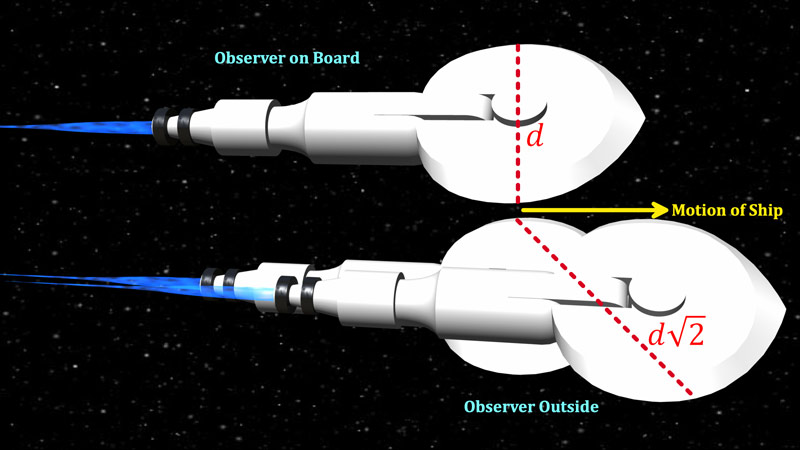
The diagram labels the width d and the diagonal d√2. That particular geometry corresponds to a ship speed c/√2: the ship moves a distance d while the pulse covers d√2. It cannot depict a massive ship moving at c.
Einstein’s special relativity supplies a spacetime description in which these differing measurements agree with one another. General relativity then makes gravity part of that geometry: matter and energy affect spacetime curvature, and freely falling bodies follow its geodesics. The familiar picture of a curved path helps, but spacetime curvature is more than a bent line in ordinary space. Gravity also affects the rate at which clocks run. The two theories extend the earlier mechanics that omitted these effects.
The relativity of speed has familiar everyday applications, such as driving. To avoid collisions, drivers must track the motion of other cars relative to their own, as well as their speed relative to the road—since posted speed limits are implicitly defined relative to the road surface. Maintaining a constant following distance behind another car requires matching its speed so that your relative speed is zero.
What the speed limit means#
Special relativity is most simply introduced using inertial frames in flat spacetime. It can also describe accelerated motion; acceleration alone does not require general relativity. The latter is needed to describe gravitational spacetime curvature. The travelling-twins analysis is an example of acceleration treated within special relativity.
The invariant speed is light’s speed in a vacuum. In water or glass, light propagates more slowly; at a boundary, a change in propagation speed can change its direction, producing refraction. “Mass increases with speed,” the terminology used in the guide, refers to relativistic mass, energy divided by c². In the invariant-mass convention, the object’s rest mass stays fixed while its energy and momentum grow. The physical consequence is the same: for an object of nonzero rest mass, the required energy diverges as its speed approaches c. Particle accelerators test that relation; they do not accelerate a massive particle to c. Relativistic energy and acceleration.
Shortform contrasts this with Pharis E. Williams’s proposed explanation: the electromagnetic influence that accelerates a particle travels at c, so it supposedly pushes less effectively as the particle catches up. Its sailboat analogy has wind pushing strongly at first and less strongly as boat speed approaches wind speed. This preserves the intuition of diminishing acceleration, but is a claim from Williams’s alternative account, not a second established derivation of relativity. An electromagnetic field is not wind overtaking a sail, and abandoning “relativistic mass” terminology does not require adopting that explanation.
Sources discussed here: Refraction · Williams’s alternative physics
General relativity gives predictions that can be compared with astronomical measurements. In 1915 Einstein accounted for the previously unexplained part of Mercury’s orbital precession: an existing anomaly in Newtonian predictions, rather than a newly discovered deviation. Much later, LIGO measured a passing gravitational-wave signal consistent with two black holes spiralling together and merging. These are different tests of the same framework. LIGO’s first binary-black-hole observation.
Gravitational waves are disturbances in spacetime geometry. A changing, nonspherical mass distribution—such as an orbiting binary—can radiate them; a massive object moving uniformly does not automatically make a gravitational wave. The source’s mass and motion matter, together with its geometry. Successful tests support the theory in the regimes examined, without proving it complete in every regime.
Sources discussed here: Tests of general relativity · About LIGO · GW150914 paper (PDF)
Expansion is evidence; an absolute beginning is a further question#
Hawking contrasts a universe created at a finite time, as in the Judeo-Christian view he discusses, with the eternal universe favored by many nineteenth-century scientists. The twentieth-century shift was driven by evidence about how the universe changes. The hot Big Bang model describes expansion and cooling from an early hot, dense state. It is not an explosion from one location into empty space. In the balloon analogy, the useful part is the increasing separation of points on the surface; the balloon’s center is not a location in that two-dimensional universe. NASA’s Big Bang explanation.
The Bryson guide records an old age range of 10–20 billion years and a commonly cited estimate of 13.7 billion. Those numbers belong to its account, not the present uncertainty range: a modern rounded estimate is about 13.8 billion years. The reconstruction of a hot early universe should also be distinguished from establishing that time had an absolute first instant; whether “before” is meaningful depends on the model of that earliest boundary. NASA cosmology glossary.
In the 1920s, Hubble’s distance–recession relation supplied evidence for expansion: distant galaxies tend to recede faster. It does not mean every galaxy recedes from us; motions within gravitationally bound systems need not follow that large-scale trend. General relativity permits a changing universe. Einstein’s historical use of a cosmological constant to construct a static model illustrates how an accepted picture can shape the use of an equation; the constant itself is not mathematically discredited by that unsuccessful purpose.
A second trace is the cosmic microwave background. A hot early universe should leave cooled radiation. Penzias and Wilson detected a nearly uniform microwave signal in the 1960s; its interpretation as relic radiation supported the hot Big Bang. Subsequent measurements of its spectrum and small variations made this a quantitative test, rather than an exact match settled by the first detection. COBE scientist John Mather on the measurements.
The guide brings together two concerns. One is a singularity: under specified classical assumptions, the Hawking–Penrose results show that spacetime descriptions cannot be continued indefinitely along certain paths. Popular accounts picture infinite density at a point. The useful conclusion is that general relativity reaches a boundary of applicability—not that physicists have observed a literal infinity or established a pointlike origin for the whole universe.
The other is fine-tuning. In the models discussed, changing the early expansion rate could stop matter from assembling into stars and galaxies or cause recollapse before planetary systems form. The question is why the relevant parameters have life-permitting values. Sensitivity to parameters does not, by itself, calculate the probability of life; that would also require a justified distribution over possible parameters.
The anthropic observation is modest: observers can find themselves only in conditions compatible with their existence. A multiverse proposal tries to turn that selection effect into an explanation by supplying many different conditions; its testability and its assumptions remain questions. Bryson offers a different thought: life evolved to fit its surroundings. That explains adaptation within an available environment, but does not by itself explain why the environment permits stars, chemistry or life at all. Shortform makes this limitation a conjecture about how scientists might respond, rather than evidence of a measured consensus. A quantum theory of gravity might revise the singularity and constrain initial conditions; the guide records Hawking’s hope that it would address both.
Newtonian gravity already makes a static distribution of mutually attracting matter problematic: why would it remain still rather than collapse? This motivates a dynamical question, but does not by itself establish one cosmic point of origin. General relativity supplies a framework for evolving spacetime; quantum gravity would have to address where that classical description fails.
Shortform’s comparison adds inflation as one proposed way to account for the early expansion behavior, while acknowledging that it does not resolve every fine-tuning question. Its account presents Hawking as preferring a theory that explains initial conditions over an appeal to infinitely many universes. That is a characterization of the argument in this guide, not a statement that Hawking rejected every multiverse idea throughout his career. In the proposal described here, a quantum theory would constrain apparently arbitrary parameters and assign substantial probability to the observed values. That remains an expectation, not an established result.
Sources discussed here: A Brief History of Time · Limits on life-permitting conditions
The same questions also appear in theology. Shortform describes Christian arguments that a temporal universe requires a cause outside its spacetime, and that life-permitting parameters suggest design. The causal argument adds a philosophical premise: the universe as a whole must have a cause even if ordinary temporal causation cannot apply before it. Calling such a cause supernatural is part of the interpretation, not something proved by the field equations. Likewise, treating fine-tuning as evidence of a designer is a theological inference, not a physical measurement. These positions differ from Hawking’s search for an account in the laws and initial conditions themselves.
Sources discussed here: Theological Big Bang argument · Theological fine-tuning argument
Stars recycle matter#
The early universe made mostly hydrogen and helium before expansion and cooling ended that phase of nuclear fusion. Small density differences then allowed gravity to assemble matter into structures; collapsing gas formed stars within the developing galaxies. Bryson reports estimates of 100–400 billion stars in the Milky Way, a range reflecting the difficulty of counting a galaxy from within it.
Stars obtain energy by fusing lighter nuclei into heavier ones. Stellar evolution and supernova explosions help enrich surrounding gas with elements such as carbon, oxygen and iron. Later generations of stars and rocky planets form from that enriched material. Different stars end their lives differently; exhaustion of hydrogen and helium alone is not a universal trigger for a supernova.
Fusion joins lighter nuclei into heavier ones. In stellar burning, fusion toward the iron group can release energy; pushing beyond that region does not provide a continuing energy source. Massive stars develop layers with different fuels: the hot core has advanced farther through nuclear burning, while outer regions still contain lighter elements.
When such a core can no longer support itself, it collapses. A shock and energy transfer involving neutrinos can expel the outer layers; some collapses instead leave a black hole. This is the core-collapse supernova picture. The unused outer fuel matters to the star’s structure, but the explosion is not generally explained by all its surface hydrogen and helium igniting at once. Other supernova classes, including thermonuclear explosions of white dwarfs, have a different mechanism. Core-collapse mechanisms.
Sources discussed here: Nuclear fusion · Supernova explainer cited by the guide
Astronomers use sensitive equipment to detect electromagnetic radiation emitted by the hot gases of the early universe, and can even image it. These images show slight intensity variations that correspond to the regional density differences in the primordial gas that eventually allowed stars and galaxies to form.
Estimates of the Milky Way’s stellar population vary because astronomers employ several different methods to measure stellar density—the number of stars per unit volume—and the galaxy’s size. Each method relies on approximations or simplifying assumptions that make a result possible, but also introduce imprecision.
References: They can even take pictures of it · astronomers use several different methods to measure the stellar density
Black holes: inference at the limit of escape#
An event horizon is a causal boundary: from inside it, future-directed light signals cannot reach distant outside observers. It is not a solid surface. For a sufficiently massive stellar remnant, the loss of pressure support can lead to collapse and black-hole formation. The gravity of an unseen companion can be inferred from a visible star’s motion; Cygnus X-1 is the historical candidate discussed by Hawking. Later observations added many more candidates and confirmed black holes through several kinds of evidence. The key method is inference from effects, not seeing light emitted by the interior.
Hawking radiation is a quantum prediction of thermal emission associated with a black hole. It does not mean a light ray escapes after being emitted inside the event horizon. Hawking’s calculation treats quantum fields in a black-hole spacetime and predicts outgoing energy with a corresponding decrease in the hole’s mass. Hawking’s 1975 paper.
The particle-pair picture is a teaching aid: a positive-energy member escapes while a negative-energy contribution crosses the horizon. “Negative energy” here is defined relative to the distant observer; it is not a synonym for antimatter. The guide’s photon–antiphoton story therefore needs repair: a photon is its own antiparticle, and there is no distinct class of antiphotons preferentially swallowed by the hole. Fermilab on self-conjugate particles.
Shortform contrasts the particle-pair story with a quantum-field or energy-density account and cites a commentator’s estimate that emission extends over a region about fifteen times the horizon’s size. The broader lesson is that field calculations can address the radiation’s spectrum and spatial distribution; they need not locate literal pair creation on an infinitesimally thin surface. The particular “fifteen times” estimate is model- and definition-dependent commentary, not a universal boundary of Hawking radiation. Nor did Hawking hide the distinction: his original paper itself presents heuristic pictures and warns against taking them literally before supplying the mathematical derivation.
Sources discussed here: Black-hole catalog · Critique of the pair analogy
Two different absences: dark energy and dark matter#
Bryson asks why cosmic expansion accelerates when ordinary attractive gravity would tend to slow it. A cosmological constant can describe an accelerating component in the equations; that is different from explaining its physical origin. The guide also records a period of earlier deceleration followed by later acceleration. The historical irony is that Einstein once used the constant to obtain a static universe, whereas a different value can describe its changing expansion.
Shortform adds alternatives: Williams proposes that weakening gravity could change inferred galaxy distances and imitate acceleration, while another proposal invokes decreasing light speed. These are proposed modifications to the inference and its assumptions. The supplied sources do not establish either as an observationally successful replacement for the standard expansion account; they must not inherit the credibility of the observations they attempt to explain.
Sources discussed here: 2001 expansion report · Williams’s changing-gravity proposal · 1999 changing-light-speed proposal
Missing mass is a different problem. Motions and gravitational lensing imply more gravitating matter than the luminous inventory supplies. Bryson’s guide reports a discrepancy of 10–100 times, a source-era range that depends on the system and what is counted as visible matter; it is not one measured ratio for the whole universe.
The guide contrasts dim ordinary objects—asteroids, faint stars and black holes—with matter that does not reveal itself through ordinary light. Shortform then cites scarce microlensing events as a challenge to explaining all the deficit with compact dark objects. That does not mean gravitational lensing generally fails to find dark matter, nor establish that “more clumped” dark matter is today’s prevailing explanation. Microlensing limits one candidate population; large-scale lensing maps a gravitational distribution. Moreover, “dark” need not mean that gravity is its only possible interaction or that nongravitational detection is impossible in principle.
Williams’s alternative, also included by Shortform, changes gravity rather than adding matter. It proposes a gravitational constant that declines over cosmic time: distant bodies would reflect earlier, stronger gravity, with changes propagating at light speed and observations reaching us after a light-travel delay. That is the proposed mechanism, not an established solution of the missing-mass problem. Testing modified gravity requires the same breadth of observations as testing dark matter; repeating the proposal alongside several mysteries does not supply several independent confirmations.
Sources discussed here: 2012 lensing discussion · 2003 microlensing discussion · Williams’s gravity proposal
The guide also mentions an excess radio background, tracing related observations to the period of Penzias and Wilson’s work and citing renewed interest in 2009. This should be separated from the cosmic microwave background that supports the hot Big Bang. Explaining the origin and strength of a radio excess is an astrophysical question in its own right. An unexplained signal is a reason to test sources, instruments and models; it does not erase the independent evidence carried by the microwave background.
Sources discussed here: Radio-background seminar · 2009 radio-excess report